What a skin booster is
Hyaluronic acid occurs naturally in the skin and binds water. Its amount falls with age, and the skin starts to look dry, thin and tired. Creams and serums leave hyaluronic acid on the surface, where it hydrates for a few hours. A skin booster places the active substance inside the skin, where it works for months.
In a regular filler, hyaluronic acid is strongly cross-linked so it holds a shape and adds volume. In a skin booster it is not cross-linked, or only lightly, so it spreads through the skin and does not form a lump. Some products add amino acids, collagen or other substances the skin uses to build its own tissue. Others, such as polynucleotides, contain no hyaluronic acid at all.
Types of skin booster used at the clinic
Profhilo
Profhilo, made by IBSA in Italy, combines high- and low-molecular-weight hyaluronic acid, 64 mg in a 2 ml syringe, bonded by heat instead of a chemical cross-linker. It spreads over a wide area from each injection point. On the face it is injected at five standard points on each side.
The protocol is two sessions about four weeks apart. A third session can help thin or sun-damaged skin. Profhilo Body is a separate, larger product for the abdomen and inner arms.
Profhilo Structura
Profhilo Structura is a denser version made for the sides of the face. It is placed in the fat layer over the cheekbone and lower cheek, where volume and support thin out with age. It suits skin that has started to sag at the sides and look hollow, when a classic filler would be too much. Early clinical reports describe improved thickness of the lateral cheek over six months.
Sunekos
Sunekos combines low-molecular-weight hyaluronic acid with six amino acids (glycine, proline, lysine, leucine, valine and alanine), the building blocks of collagen and elastin. It is designed to help the skin rebuild both proteins. Sunekos Performa is used under the eyes for thin, crepey skin and dark circles, often together with a laser at the clinic.
A Sunekos course on the face is four treatments two weeks apart. Dr. Meir often adds a collagen injection in two of those four sessions.
Collaju collagen
Collaju is a Korean injectable containing about 3% type I atelocollagen, a purified collagen with the parts that most often trigger allergy removed. It supplies collagen to thin skin and acts as a scaffold that draws the skin’s own cells to make more. It is used under the eyes, on fine lines of the forehead and around the mouth, and on the neck. The collagen is of porcine origin. Independent clinical studies on this brand are limited, so claims rest mostly on the manufacturer’s data and on research on similar collagen products.
Polynucleotides (PDRN)
Polynucleotides are DNA fragments purified from salmon. They support skin repair and are used mainly for texture, enlarged pores and shallow acne scars. Unlike hyaluronic acid boosters, they cannot be dissolved with hyaluronidase.
Exosomes
Exosomes are tiny vesicles that cells release to send signals to one another. Each carries growth factors, proteins and genetic material such as microRNA. In skin, the aim is to signal fibroblasts to produce more collagen and elastin and to speed repair after a laser or microneedling. In hair, the aim is to support thinning follicles.
Exosomes are a growing treatment at the clinic. Dr. Meir uses two kinds: a laboratory product from a human cell source, and a preparation made from the patient’s own blood, concentrated well beyond standard PRP. They are often delivered with the NovoJet needle-free injector, or applied right after a treatment that opens channels in the skin, since exosomes do not cross the outer skin layer by themselves. A face course is usually four sessions two weeks apart, about half an hour each with numbing cream.
Be clear about the evidence and the rules:
- Regulation. The US FDA has stated that no exosome product is approved to treat any disease or condition, and it has warned about unapproved products sold by clinics. Rules differ between countries. Many products are sold as cosmetics or for topical use.
- Research. Human studies show improvement in skin texture, hydration and healing after laser, and in hair density, but most are small, short and use different products.
- Products differ. Two products called “exosomes” can contain different amounts and types of growth factors, depending on the source cells and how they were processed.
Note: At the clinic, exosomes are an add-on to established treatments. On a bald scalp, in a receding hairline or in scars where no hair remains, no injection will grow hair, whether exosomes or PRP.
Who skin boosters suit
Boosters suit women and men whose skin looks dry, dull or tired, or has fine lines and uneven texture. They work at a young age to preserve skin quality and at an older age to restore it. Good areas include:
- the neck and chest, where volumising filler fits poorly
- the backs of the hands, where skin thins with age
- the under-eye area
- texture after acne and enlarged pores, where PDRN suits best
- skin over filler, to improve its quality after volume is restored
- darker skin, where strong lasers call for caution
A booster alone is not enough for every problem. Lost volume in the cheeks and temples needs filler or a biostimulator. Sagging needs a tightening method such as Morpheus8, Endolift or HIFU. Expression lines on the forehead and between the brows respond to botox.
How the treatment is done at the clinic
- Consultation. Dr. Meir examines the skin, chooses the product and sets the number of sessions. A recent photo of the face helps.
- Numbing. Anaesthetic cream on the area.
- Injection. Small amounts are placed at many points with a fine needle, with a cannula on larger areas, or with NovoJet for exosomes and some boosters.
- Afterwards. Small bumps show at the points and settle within a day or two.
Dr. Meir injects a skin booster about a week before plasma and laser treatments, so the skin arrives in better condition and heals more easily. For maintenance he recommends a booster together with NeoGen once every six months.
Recovery and side effects
You can return to work the same day. Because of the bumps, avoid booking a session the day before an event. For the first days, do not massage the area, and skip makeup, saunas and hot baths for about a day or as advised.
Common effects: bumps at the injection points, mild redness and swelling for a few days, small bruises (more often with blood thinners). Rarely, a small lump remains and softens with time. Blocked blood vessels are very rare with dilute boosters, but sharp pain or spreading pallor during injection needs immediate treatment. Hyaluronic acid boosters can be dissolved with hyaluronidase.
Boosters are not injected during pregnancy or breastfeeding, over active infection or a cold sore, or with a known allergy to the ingredients. Active autoimmune disease needs a separate decision. For exosomes, Dr. Meir also asks about any cancer history.
Results and timeline
The skin holds moisture better and reflects light more evenly within one to two weeks. The peak comes about a month after the last session of the series: smoother texture, softer fine lines and skin that feels thicker and more elastic. The change is gradual, so it shows more clearly in photos taken in the same light than in the mirror from day to day.
The result lasts several months, depending on the product and your skin. A single refresher session keeps it. Unprotected sun and smoking shorten the effect, so daily sunscreen is part of the treatment.
How to choose a skin booster
- Profhilo for dull, dehydrated, slightly lax skin on the face and neck, with only two sessions.
- Profhilo Structura for early hollowing and sagging at the sides of the face.
- Sunekos for thin, crepey skin and the under-eye area.
- Collaju for thin skin and fine lines, often combined with Sunekos or a biostimulator.
- PDRN for texture, pores and shallow scars.
- Exosomes as an add-on for repair after laser or microneedling, and for thinning hair alongside proven treatments.
Dr. Meir sets the choice at the consultation and explains what the booster will change and what it will not.
Results from the clinic
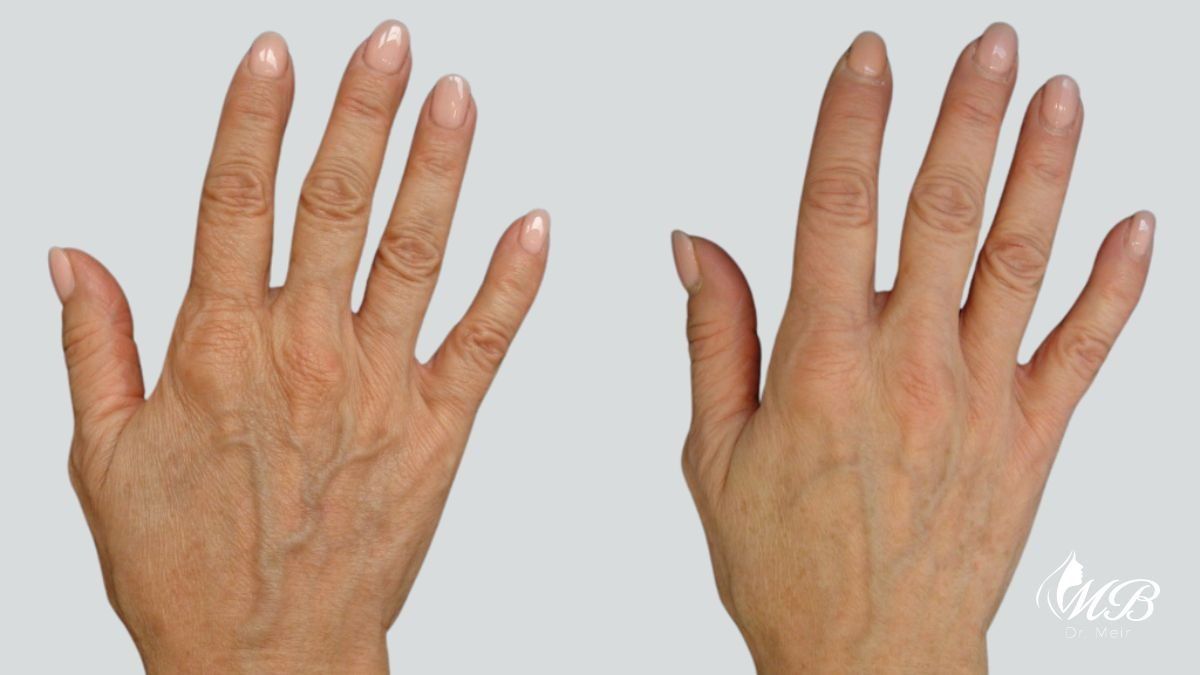
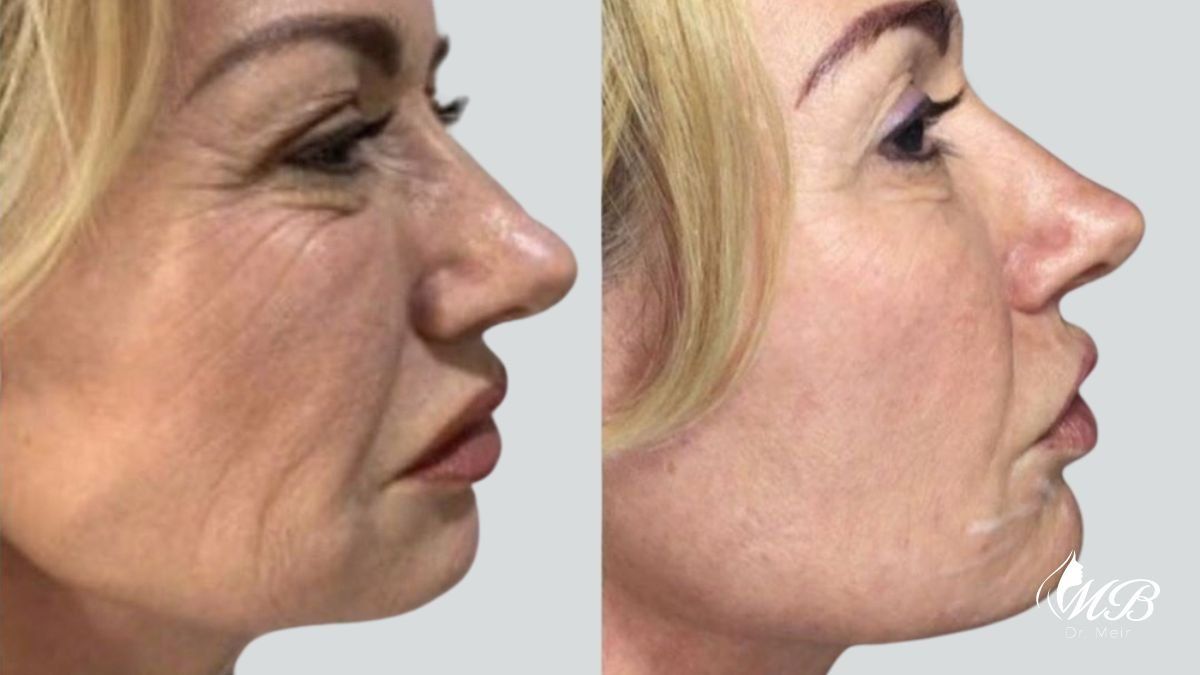
Individual results vary. Photos published with patient consent.
Questions
What is the difference between a skin booster and a filler?
A filler adds volume and changes shape, such as a higher cheek or a defined chin. A skin booster improves the quality of the skin and leaves your features as they are. Many plans use both.
How many Profhilo sessions do I need?
The standard protocol is two sessions about four weeks apart. Some patients with thin or sun-damaged skin benefit from a third session.
Are exosome treatments approved?
The US FDA has stated that no exosome product is approved to treat any condition. Regulation differs by country, and the research is early. At the clinic, exosomes are an add-on to established treatments, never a stand-alone cure.
What is NovoJet?
NovoJet is a needle-free injector. It uses pressure to deliver a fine jet of product into the upper layers of the skin. The clinic uses it for exosomes and some skin boosters.
Does a skin booster hurt?
Numbing cream goes on first and the needle is very fine. Most people feel small pricks. Thin areas such as under the eyes and around the mouth are more sensitive.
Is Collaju suitable if I avoid pork products?
Collaju contains collagen of porcine origin. Raise this at the consultation if it matters to you for dietary or religious reasons, and Dr. Meir will suggest an alternative.
How long does a skin booster last?
After a full series the result holds for several months, depending on the product and your skin. A single refresher session maintains it without restarting the series.
Related
Sources: US FDA: Consumer alert on regenerative medicine products including stem cells and exosomes; Profhilo hybrid hyaluronic acid complexes in facial rejuvenation: open-label study; Profhilo Structura for the lateral cheek fat compartment: pilot study