
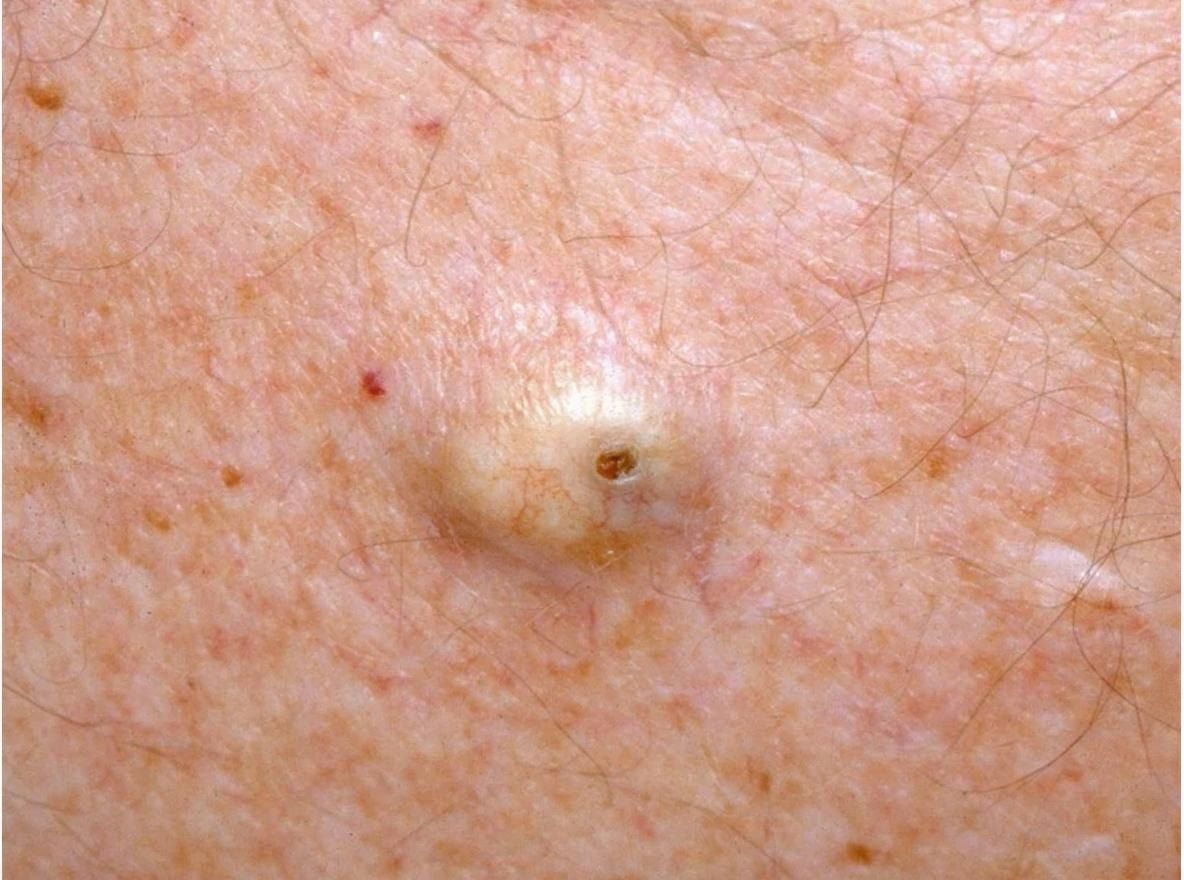
Two common lumps under the skin
Most lumps people find under their skin are one of two things. A sebaceous cyst, also called an epidermoid cyst or atheroma, is a closed sac in the skin filled with keratin, the cheesy material made by skin cells. A lipoma is a soft, slow-growing lump of fat cells that lies deeper, in the fatty layer under the skin. Both are benign. They differ in how they feel, how they behave and how they are removed.
Sebaceous cysts
An epidermoid cyst forms when surface skin cells become trapped below the skin, often around a blocked hair follicle. It appears as a dome-shaped lump on the face, neck, back, chest or behind the ears, often with a small dark opening (punctum) on top. It starts soft, does not hurt and can firm up over time. If it bursts or gets infected, it becomes red, hot and painful, and may drain foul-smelling material.
A pilar cyst is a related type that grows from the hair root, mostly on the scalp. It often runs in families and appears in several places at once. Its wall is thicker, which makes it easier to remove whole through a small cut.
Lipomas
A lipoma feels soft and rubbery and moves under the skin when pushed. It usually sits on the shoulders, back, neck, arms or thighs and grows slowly over years. Most do not hurt. Some people have several. A lipoma becomes a reason to remove it when it grows, presses on something, hurts or bothers the patient.
Diagnosis
Dr. Meir examines the lump and asks how long it has been there, whether it has changed and whether it has been inflamed. Most cysts and lipomas are diagnosed by examination alone. Ultrasound helps when the lump is deep, large or unclear, or when an inflamed cyst needs to be told apart from an abscess.
Several conditions look like a cyst: a boil or abscess, hidradenitis in the armpits and groin, an enlarged lymph node and, rarely, a tumour. A lump larger than about 5 cm, one that grows fast, feels hard or fixed, or sits under the muscle needs imaging before any procedure. Many cysts in one person can point to a hereditary condition and justify further checks.
Why squeezing does not work
The contents of a cyst sit inside a wall, or capsule. Squeezing may push out some of the material, but the wall stays in place and keeps producing keratin, so the sac refills. Worse, pressure can rupture the cyst into the surrounding tissue, trigger inflammation and infection and leave a larger scar. Pricking it at home with a needle has the same problem. Only removal of the whole wall prevents a cyst from coming back.
How removal is done at the clinic
Removal of cysts and lipomas takes place at the clinic in Holon under local anaesthetic. You are awake, the area is numb, and most people go home within the hour.
Full excision of a cyst. The doctor makes an incision along the natural skin lines, frees the sac and removes it whole together with its wall. The wound is closed with stitches. This is the method that keeps recurrence low.
Minimal excision. For a small, calm cyst, a short cut or a small punch opening lets the doctor empty the contents and draw the wall out. The scar is smaller, though it is harder to be sure the whole wall came out.
Lipoma excision. A cut is made over the lipoma, the fatty lump is separated from the tissue around it and removed, and the wound is closed in layers. A lipoma has a thin capsule, and removing it completely keeps recurrence low.
Removed tissue is sent to pathology, even when the lump looks routine.
Note: A larger or deeper lipoma may need a planned procedure rather than a clinic visit. Dr. Meir tells you at the consultation which setting suits your lump.
Face or body: where the lump sits changes the decision
Every removal leaves a scar, so location drives the decision.
On the face, a cyst that does not grow, hurt or get inflamed is often left alone. The scar from removal can bother the patient more than the cyst itself. If a facial cyst keeps getting inflamed or grows, it is removed while calm, through a small cut placed in the natural lines of the face.
On the body, removal is usually recommended, accepting that a scar will remain. Cysts on the back, chest and groin tend to become inflamed again and again, and each episode makes later removal harder and the scar larger.
The chest, shoulders and upper back carry a higher risk of thick or keloid scars. Patients with a personal or family history of raised scars discuss this before any removal, and silicone sheets or steroid injections can be used early if the scar starts to thicken.
Infected or inflamed cysts
Signs of infection are pain, redness, warmth around the lump and sometimes discharge with a bad smell. Fever or feeling unwell calls for prompt medical care.
An inflamed cyst is not removed in the acute phase. Inflammation breaks down the wall, so it cannot be identified and removed whole, and early removal leads to frequent recurrence. The approach in stages:
- Calm the acute phase. A tense, painful cyst is opened and drained under local anaesthetic, and a sample is taken for culture. Antibiotics are added when there is spreading infection. A cyst inflamed without infection can be injected with a small dose of steroid to settle it.
- Wait. Warm compresses help for the first days. The area needs several weeks, usually four to six, to settle fully.
- Remove the whole cyst once it is calm, so the wall can be taken out completely.
Drainage alone empties the cyst but leaves the wall, so a cyst that was only drained will often fill again.
Recovery and scarring
After removal you leave with a dressing. Keep it clean and dry for the first one to two days. Stitches come out after about 7 days on the face, about 10 on the neck and about 14 on the back and shoulders. Avoid exercise that stretches the wound until then.
The scar is pink at first and fades over months. Sun protection on visible scars helps them fade evenly. A scar that stays red or becomes raised can be treated later. Call the clinic if you notice increasing pain, spreading redness, discharge or fever.
How to choose
Choose a doctor who examines the lump before removing it, removes the whole cyst wall and sends the tissue to the lab, and who tells you honestly when leaving a facial cyst alone is the better option. Consultations at the clinic in Holon are in Hebrew, English and Russian. You can send a photo of the lump on WhatsApp beforehand to help plan the visit.
Questions
Can I squeeze a sebaceous cyst?
No. Squeezing removes some of the contents but leaves the wall, so the cyst refills. Pressure can also burst it into the surrounding tissue, cause inflammation and leave a worse scar.
Will the cyst come back after removal?
When the whole wall is removed, recurrence is uncommon. Drainage alone empties the cyst but leaves the wall, so it often comes back.
Should a cyst on the face be removed?
Not always. On the face, a cyst that does not grow, hurt or get inflamed is often left alone, because any removal leaves a scar. On the body, removal is usually recommended, accepting a scar.
Can an infected cyst be removed right away?
Usually not. While it is inflamed, the wall breaks down and cannot be removed whole. The cyst is drained and treated first, and full removal is planned once it has settled for several weeks.
How do I know whether it is a cyst or a lipoma?
A cyst sits in the skin, feels firmer and often has a small dark opening on top. A lipoma lies deeper, feels soft and rubbery and moves under the skin. An examination, sometimes with ultrasound, confirms it.
Is a lipoma dangerous?
A lipoma is a benign lump of fat. A lump larger than about 5 cm, one that grows fast, feels hard, hurts or sits deep under the muscle needs imaging before removal.
Related
Sources: NHS: Lipoma; DermNet: Epidermoid cyst