
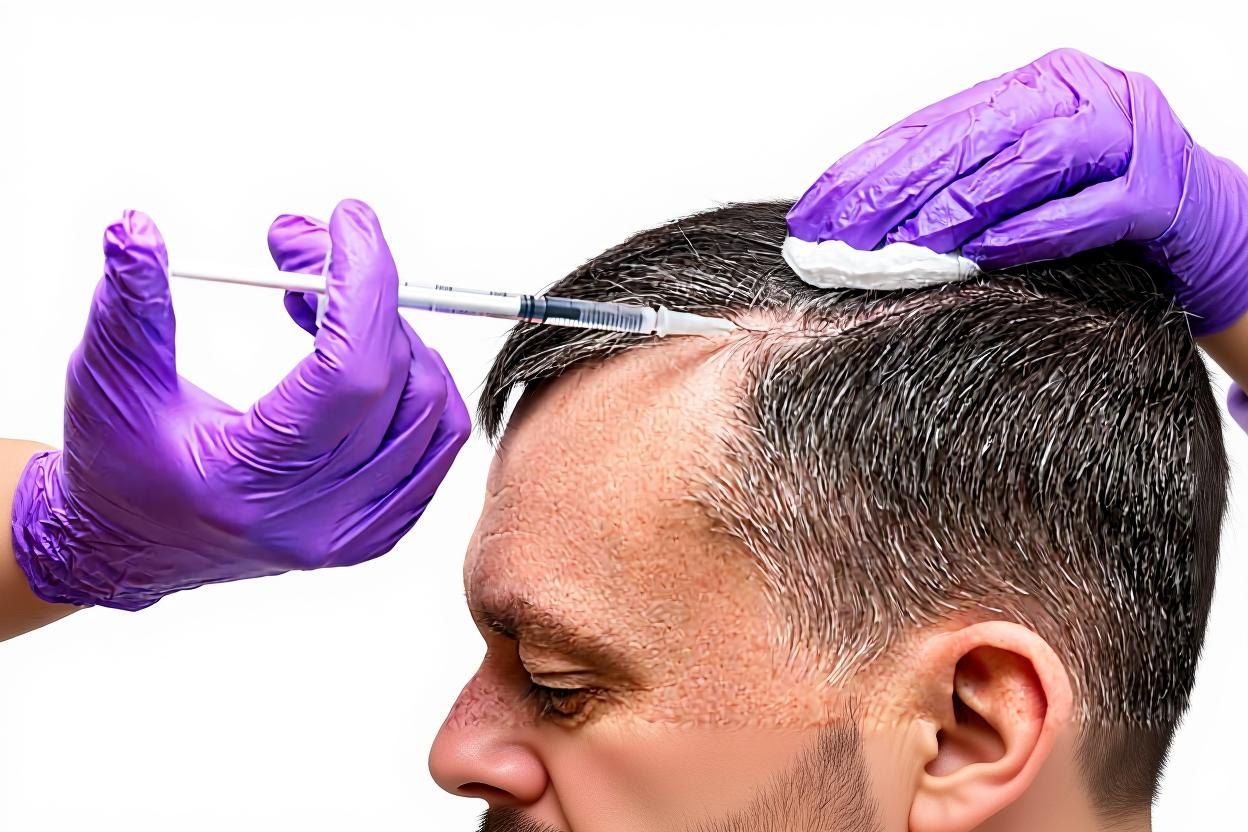
What PRP for hair is
PRP stands for platelet-rich plasma. A small amount of your blood is drawn and spun in a centrifuge, which separates it into a red layer and a yellow layer. The yellow plasma holds a concentrate of platelets and the growth factors they release, such as PDGF, VEGF and IGF-1. That plasma is injected into the scalp.
The growth factors support follicles that have weakened and shrunk. The aim is thicker existing hair and slower loss in thinning areas. A follicle has to be alive to respond, so PRP does not grow hair on skin that has been bald for years.
Who PRP suits
PRP suits men and women with androgenetic (pattern) hair loss at an early or moderate stage, while hair is thinning and follicles are still present.
- Diffuse thinning on the crown and top of the scalp.
- Pattern hair loss with normal density so far, as prevention and maintenance.
- Alopecia areata, alongside steroid treatment.
- Before and after a hair transplant, to protect native hair.
In men thinning usually starts at the crown and front hairline. In women it spreads over the top and the parting looks wider. Either way the treatment covers the whole upper scalp, and not only the thinnest spot.
PRP is less suitable or needs a different plan in these cases:
- Fully bald areas, such as a bare receding temple. A transplant is the option there.
- Scarring alopecia. Scarred skin does not respond, and the priority is to stop new inflammation.
- Sudden heavy shedding that began a few months after stress, illness or childbirth. This is often telogen effluvium, and the trigger is checked first.
Note: PRP supports medication and does not replace it. Published trials found better results when PRP was combined with minoxidil and finasteride than with the medication alone. Most patients at the clinic use both.
How Dr. Meir performs the treatment
Dr. Meir takes the blood and gives every injection himself. Each session runs the full process from the start:
- Blood draw from a vein, like a routine blood test.
- Centrifuge to separate the platelet-rich plasma.
- Scalp numbing to reduce injection pain.
- About fifty injections with a fine needle across the top of the scalp and the margins at the sides and back.
All equipment is sterile and single-use, and the plasma is prepared and injected in the same visit. Since the material comes from your own body, there is no allergic reaction to it, and the treatment can be repeated for years as part of maintenance.
Dr. Meir plans the treatment from the examination, the history and photos. He photographs the scalp before the course and again about six months later, from the same angles and under the same light, because photos show changes that the mirror hides.
The protocol
| Situation | Frequency | Goal |
|---|---|---|
| Starting course | 3 to 4 sessions, once a month | Thicker hair, slower loss |
| Maintenance after the course | Every 3 to 6 months | Keep the result |
| Pattern hair loss with normal density | Every 3 months | Prevent thinning |
| Alopecia areata | 3 sessions a month apart, with steroid injections | Regrowth in the patch |
Sessions are spaced at least a month apart.
Preparation and recovery
Before: come with clean hair. Colour your hair before treatment day, not after. Avoid anti-inflammatory painkillers such as ibuprofen for a few days before and after, and mention any blood thinners at the consultation. No fasting is needed.
After: there is no downtime and you can return to work the same day. The injections do not make existing hair fall out. Home products prescribed alongside the course are applied at night before sleep.
Side effects and who should wait
Side effects are mild and short-lived:
- Pain during injection, which is the main complaint and is reduced by numbing.
- Redness and slight swelling of the scalp for a day or two.
- Tenderness to touch, usually gone within a day.
- Small bruises, mostly in people who took anti-inflammatories around the session.
At the consultation Dr. Meir checks for conditions that call for caution or delay: blood disorders and clotting problems, a low platelet count, anticoagulant treatment, an active scalp infection, and a chronic illness that is not under control.
What the evidence says
The evidence for PRP in pattern hair loss is moderate. A 2023 meta-analysis of nine randomised trials found higher hair density at three and six months compared with placebo. A 2024 review reached a similar direction but rated the certainty of the evidence as low to very low, because the studies are small and use very different methods.
There is still no agreement on the best preparation method, platelet concentration or interval between sessions. In practice this means PRP thickens hair in most people who respond, to a moderate degree. Someone expecting full hair on a bald area will be disappointed. Someone who wants to slow thinning and add thickness to existing hair gets a treatment with a reasonable research base.
Results and timeline
The first change usually shows after about three months, and the peak comes at around six months. The hair cycle is slow, so judging after one or two months is too early.
Most patients see thicker hair. In some the improvement is mild, and in a minority the gain is that the loss stops. Nobody can promise a result for a specific person, and only the end of the course shows how the scalp responded. The result fades gradually without maintenance, because the genetic cause keeps working. Response is better when thinning started recently and plenty of hair remains.
Combining PRP with exosomes or mesotherapy
Exosomes are tiny particles that carry growth signals between cells. At the clinic they are delivered with the NovoJet needle-free injector in a series of five sessions, with maintenance every three to six months. Another option is exosomes concentrated from the patient’s own blood, given once a year. Exosomes mean fewer visits a year than PRP. Their research base is younger than that of PRP, and Dr. Meir presents them that way.
Mesotherapy delivers micro-injections of vitamins, amino acids and peptides into the scalp. It can support recovery after reactive shedding, for example after childbirth once breastfeeding has ended. The evidence is thinner than for PRP, so it serves as a supporting option.
The choice between PRP, exosomes and mesotherapy depends on the type of hair loss, the medication you already take and how many visits suit you. Dr. Meir sets it at the consultation.
How to choose a clinic
Look for a doctor who confirms the type of hair loss before starting injections, performs the procedure personally, uses sterile single-use kits and tracks the result with standardised photos. Dr. Meir has more than 20 years of experience and treats patients at the clinic in Azrieli Holon Center in Hebrew, English or Russian. To book a consultation, message the clinic on WhatsApp at 053-566-2287.
Questions
Does PRP for hair hurt?
Injection discomfort is the main side effect. The scalp is numbed first, and most patients describe the session as mildly uncomfortable. Tenderness afterwards usually fades within a day.
Does PRP work on a receding hairline?
Not on temples that are already bald, because there are no active follicles left. There a transplant is the option. PRP helps where hair is thinning and follicles are still present.
Is PRP suitable for women?
Yes. Women with diffuse thinning on top of the scalp respond in the same way as men. Reactive shedding after childbirth or illness is ruled out first, because it often settles without treatment.
How long do PRP results last?
The genetic cause keeps working, so the result is not permanent. Without maintenance sessions the improvement fades gradually over the following months.
What should I avoid before and after PRP?
Avoid anti-inflammatory painkillers such as ibuprofen for a few days before and after, because they weaken platelet activity. Colour your hair before the session and come with clean hair.
Can PRP be done after a hair transplant?
Yes. PRP helps preserve the native hair around the grafts, and the transplanted area can also be treated.
Related
Sources: Platelet-Rich Plasma for Androgenetic Alopecia: A Systematic Review and Meta-Analysis of Randomized Controlled Trials. J Cutan Med Surg 2023; Is autologous platelet-rich plasma capable of increasing hair density in patients with androgenic alopecia? PLoS One 2024