
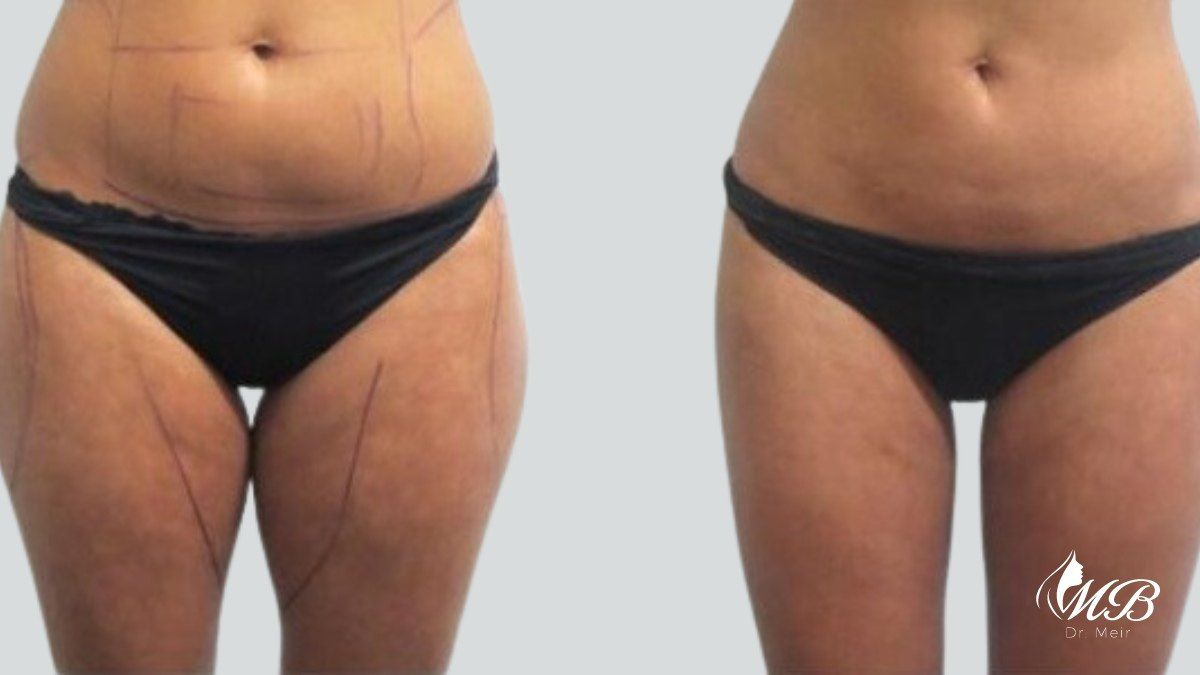
What thigh liposuction treats
The thighs hold fat that often stays after diet and training, especially in women. Thigh liposuction reshapes several distinct zones, and each behaves differently:
- Outer thighs (saddlebags). A bulge on the side of the upper thigh. The fat is firm and the skin here is thick, so the area usually responds well.
- Inner thighs. Fat that makes the thighs rub when you walk. The skin is thin and loosens easily, so tightening is often part of the plan.
- Inner knees. A soft pad of fat above and inside the knee that makes the leg look shapeless.
- The fold under the buttock (banana roll). A roll of fat where the buttock meets the thigh. Suction here needs restraint, because too much removal can make the buttock sag.
- Around hip dips. When the dip below the hip bone is framed by fat above and below it, removing that fat smooths the line. When the dip comes from bone shape, filling it with fat or a biostimulator suits better.
Before planning, Dr. Meir examines the legs standing, checks the skin quality and pinches each zone. He also looks for signs of lipedema, which changes the approach.
Who is a good candidate
The right candidate is at a stable weight with localised fat in one or more of these zones and skin that can still contract. Liposuction reshapes the legs and does not replace weight loss.
Skin quality decides the method. When the skin is elastic, liposuction alone gives a smooth line. When the skin is thin or slightly loose, mostly on the inner thigh, Dr. Meir adds Quantum RF so the skin contracts over the new contour. When the skin is very loose, for example after major weight loss, liposuction alone can make it look worse, and a surgical thigh lift is the better path.
Liposuction does not treat cellulite. It removes volume, and if the skin does not contract it can make an existing cellulite pattern more visible.
Lipedema
Lipedema is a chronic condition of fat tissue, seen almost only in women. Fat builds up symmetrically in the legs, and sometimes the arms, while the feet stay slim. The legs feel heavy and tender and bruise easily. It often begins or worsens around puberty, pregnancy or menopause, and diet does not reduce the affected fat.
Dr. Meir uses liposuction as the main surgical treatment for lipedema. The suction is deeper and covers the whole circumference of the leg, to avoid a lumpy look, and the skin of the thighs is tightened in the same operation, mainly on the inner side where it is loose. Because of the safety limit of about 5 litres per operation, the thighs are treated first and the calves about six months later.
Note: liposuction does not cure lipedema. It can reduce the volume of abnormal fat and, for many patients, the pain and heaviness. Compression garments, lymphatic drainage and weight control remain part of long-term care, and pregnancy or menopause can affect untreated areas. UK guidance from NICE still describes the evidence for this surgery as limited.
How it is done at the clinic
- Consultation in Holon. Examination standing, a skin assessment, a review of your medications and blood tests, the choice of anaesthesia and a written price.
- Preparation. Blood tests, and an ECG before general anaesthesia. Blood thinners are stopped in coordination with your treating doctor. Dr. Meir may ask for an ultrasound of the leg veins before larger procedures.
- The operation. Dr. Meir performs it himself in an accredited medical centre’s operating room. The zones are marked with you standing. Tumescent fluid numbs the tissue and reduces bleeding. Through small incisions placed in natural creases, the fat is suctioned in layers so both legs match.
- Skin tightening. Quantum RF delivers radiofrequency energy under the skin where needed, usually on the inner thighs.
- Home the same day, with a companion. Antibiotics start right after the operation for 5 days.
Anaesthesia can be local, sedation or general, depending on the number of zones and the volume. The operation takes about one to one and a half hours, depending on the case.
Recovery
- Days 1 to 3: swelling, bruising and soreness. The inner thighs can be more uncomfortable because of friction. Cold compresses and raising the legs help. Stand up slowly, as mild dizziness can occur in the first days.
- Days 3 to 7: most patients return to office work. Light walking every day.
- Weeks 1 to 3: a compression garment almost day and night, usually about three weeks, depending on the swelling. After lipedema surgery, compression lasts longer.
- Weeks 4 to 6: gradual return to running, cycling and leg training.
- Months 3 to 6: the final shape of the legs shows.
Manual lymphatic drainage in the first weeks can shorten the swelling. Follow-up visits take place at the clinic in Holon.
Risks and side effects
Expected effects are swelling, bruising, soreness and temporary numbness. Aesthetic risks include an uneven contour, asymmetry between the legs, a more visible cellulite pattern and, under the buttock, a sagging fold if too much fat is removed.
Medical risks include infection, a fluid collection (seroma), and blood clots in the leg veins. Early walking, stopping blood thinners, antibiotics and the compression garment lower these risks. Sensation in the skin usually returns over several months.
Results and how long they last
Removed fat cells do not return. A stable weight keeps the new shape of the thighs for years. Weight gain can enlarge the remaining fat cells and add fat to areas that were not treated.
Choosing your plan
Thighs are often combined with the knees, the flanks, the abdomen or the back for a balanced silhouette. The total stays within about 5 litres per operation, and larger plans are split into two stages. Fat freezing and external laser devices are mostly ineffective on the thighs in Dr. Meir’s experience, and the clinic does not use them.
The clinic is private and patients pay privately. Consultations take place in Hebrew, English and Russian at Ha-Rokmim 26, Azrieli Holon Center, Building B, 4th floor. Call or message on WhatsApp: 053-566-2287.
Results from the clinic
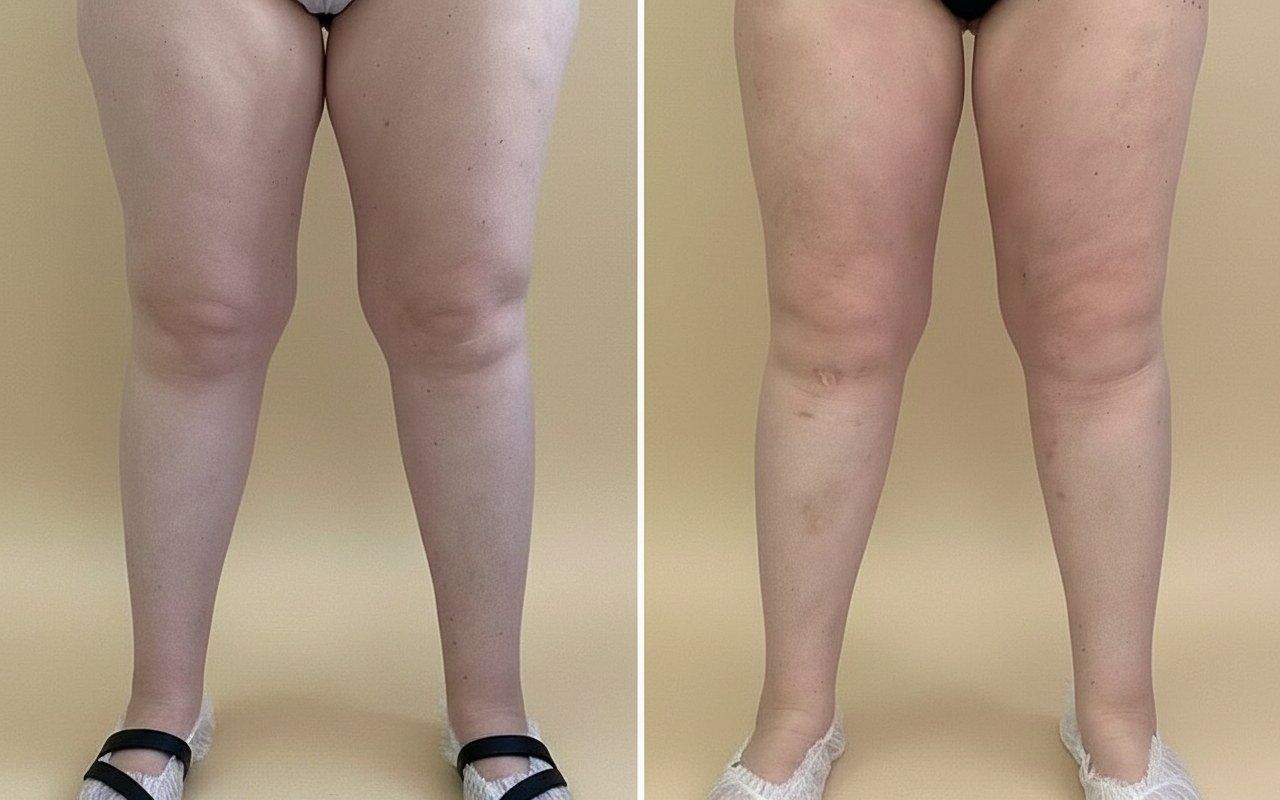
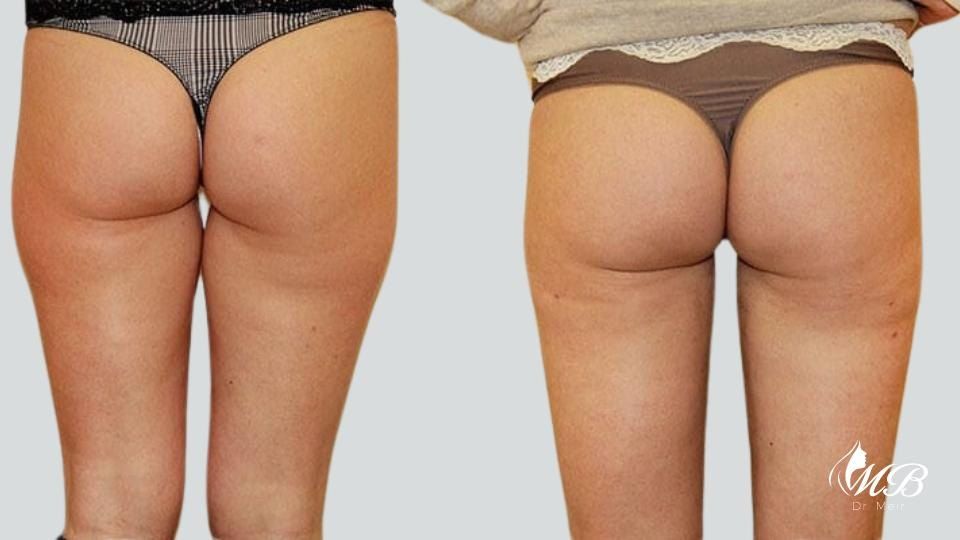
Individual results vary. Photos published with patient consent.
Price
| Liposuction, one area | ₪8,000–16,000 |
| Comprehensive liposuction | ₪15,000–50,000 |
The final price depends on the extent of treatment and is given at the consultation.
Questions
Is inner thigh liposuction harder than other areas?
The inner thigh has thin skin and is exposed to friction, so recovery there can be more uncomfortable and the skin may need tightening. Dr. Meir usually adds Quantum RF on the inner thigh.
Does liposuction help lipedema?
Liposuction can reduce the abnormal fat and, for many patients, the heaviness and tenderness. Lipedema is a chronic condition, so compression and follow-up stay part of life after surgery, and no treatment cures it.
Can I walk after thigh liposuction?
Yes. Light walking starts on the first day and helps prevent clots. The first days can feel stiff and sore, so stand up slowly.
Can thighs be combined with other areas?
Yes. Thighs are often combined with the knees, the flanks or the abdomen, as long as the total volume stays within the safe limit of about 5 litres per operation.
Will liposuction remove cellulite?
No. Liposuction removes fat volume and can make an existing cellulite pattern more visible if the skin does not contract. Skin tightening during the operation reduces this risk.
Can I have the consultation in English?
Yes. Dr. Meir consults in English, Hebrew and Russian at the clinic in Holon.
Related
Sources: NHS: Lipoedema; NICE: Liposuction for chronic lipoedema (HTG618); NHS: Liposuction