
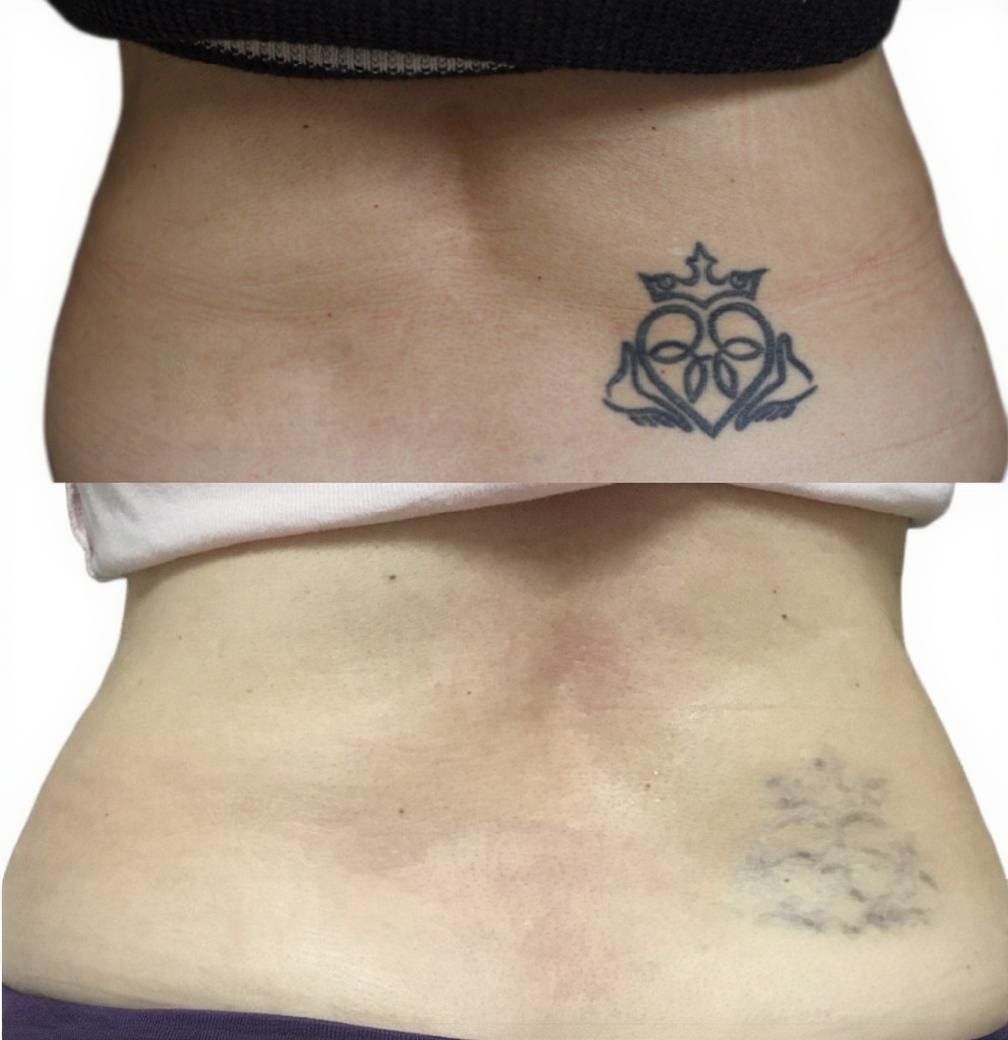
How a laser removes a tattoo
Tattoo ink sits in the dermis, deeper than the surface layer that renews itself. The ink particles are too large for immune cells to carry away, which is why a tattoo stays. A Q-switched laser fires pulses lasting billionths of a second. The ink absorbs the light, heats up in an instant and shatters into fragments. The skin around it is spared.
After each session, immune cells collect the fragments and carry them away through the lymphatic system. The tattoo fades layer by layer over the weeks that follow. This explains two facts patients often find frustrating: removal takes a series, and sessions cannot be packed close together.
At the clinic in Holon, tattoos are treated with the TORO laser by DEKA, a Q-switched Nd:YAG laser. The 1064 nm wavelength reaches deep and suits dark inks and darker skin. The 532 nm wavelength is absorbed by red and some warm colours.
Why ink colour matters
Each colour absorbs a different part of the light spectrum.
- Black and dark blue absorb a wide range and respond best.
- Red and orange respond to the 532 nm wavelength, often over more sessions.
- Green and turquoise are the most stubborn, and some traces may stay.
- White, flesh tones and light yellow behave unpredictably. Some of these inks contain titanium dioxide or iron oxide and can turn dark grey right after a pulse.
The tattoo itself matters as well. Amateur tattoos with uneven, shallow ink often fade faster than professional ones with dense, deep ink. An old tattoo that has already faded responds better than a new one. Tattoos on the hands, feet and lower legs, far from the centre of circulation, tend to clear more slowly.
Cosmetic tattoos and eyebrows
Permanent make-up on the eyebrows, lips and eyeliner needs extra caution. Many cosmetic pigments are flesh-toned, brown or white and contain metal oxides that can darken under a Q-switched laser instead of fading. The safer approach is a small test spot, with the response checked before the whole area is treated. Eyeliner close to the eye is a special case, and the eye must be fully protected. Eyebrow hair in the treated zone can lighten for a while.
Who it suits and when to wait
Most adults with a tattoo they want removed or faded can be treated. Treatment waits during pregnancy and breastfeeding, with a fresh tan on the area, with an active infection or skin disease in the tattoo, and for at least a month after a new tattoo. A history of keloids, light-sensitising medication and isotretinoin (Roaccutane) are discussed at the consultation.
Some people want a cover-up rather than full removal. Fading the old design enough for a tattoo artist to work over it takes fewer sessions. Let the skin heal for at least six weeks after the last session before getting the new tattoo.
How a session goes at the clinic
- Consultation. Dr. Meir examines the tattoo, its colours and your skin type, explains how many sessions are realistic for the first stage, and photographs the area to track progress.
- Numbing. An anaesthetic cream goes on about an hour before the session.
- The laser. The skin is cleaned and the laser passes over the ink. Most patients compare each pulse to a rubber band snapping on the skin. The treated area turns white for a few minutes, a reaction called frosting caused by gas released in the skin.
- Dressing. An ointment and a dressing cover the area. A session takes from about 5 to 30 minutes depending on size.
The first stage is a series of five sessions about six weeks apart. The gap gives the body time to clear the broken ink. Coming back sooner does not shorten the road.
Note: Do not pick or peel crusts and blisters. This is the most common route to a scar or a pale patch after tattoo removal.
Aftercare between sessions
Redness, swelling, pinpoint bleeding, blisters, crusts and peeling are normal and usually heal within one to two weeks. In the first days:
- Wash gently with lukewarm water and an unscented soap, and pat dry.
- Keep a thin layer of moisturising or repair ointment on the area, under a dressing at first.
- Avoid heavy sweating, swimming pools, the sea, saunas and baths for about two weeks.
- Cover the area and apply SPF 50 throughout the months of the series.
Contact the clinic if redness spreads, the area gets hotter, pus appears or pain increases after the third day.
Risks and side effects
The main risks are a burn, scarring, changes in skin colour and incomplete removal. Lighter skin patches (hypopigmentation) happen when the laser also removes the skin’s own pigment. Mild cases recover, and severe ones can last, more often in dark skin. Darker patches usually fade with time and sun protection. Allergic reactions to old red ink are uncommon and need a medical decision before further treatment.
Results and timeline
Lightening is often visible after the first sessions, and a clearer picture forms by the third. Many tattoos clear fully, and some leave a faint shadow or a stubborn colour. Small black tattoos tend to need fewer sessions than large, multicoloured or professional ones. After the first five sessions Dr. Meir reviews the photographs with you and decides whether to continue.
How to choose
Ask which laser and wavelength will treat each colour, how the clinic handles cosmetic and white inks, and whether progress is photographed at each visit. Be wary of anyone who promises an exact number of sessions in advance. Consultations at the clinic in Holon are in English, Russian and Hebrew, and you can send a photo of the tattoo on WhatsApp at 053-566-2287.
Results from the clinic
Individual results vary. Photos published with patient consent.
Questions
How many sessions does tattoo removal take?
Nobody can say for sure at the first visit. The clinic starts with a series of five sessions about six weeks apart and decides on the next steps by how the ink responds. Colour, depth, age and size of the tattoo all change the number.
Will the tattoo come off completely?
In most cases it does. Sometimes one colour stops responding and a faint trace remains. Burns and changes in skin colour are the other possible complications.
Does laser tattoo removal leave a scar?
With correct settings and good aftercare, scarring is uncommon. The risk rises when crusts are picked, when the skin is treated too aggressively, and on skin prone to keloids.
I got a tattoo a few days ago and regret it. Can it come off now?
Not yet. Fresh tattoo skin is still healing, and laser is a second injury on top. Wait at least a month. If you still want it removed after that, the series can start.
Why wait six weeks between sessions?
The body needs the time to carry away the broken ink through the lymphatic system. A session sooner does not speed up the result and puts more strain on the skin.
Can I have tattoo removal while pregnant?
No. Its safety in pregnancy and breastfeeding has not been tested, so treatment waits until afterwards.
Related
Sources: American Academy of Dermatology: Tattoo removal, lasers outshine other methods; American Academy of Dermatology: How to care for your skin after tattoo removal