
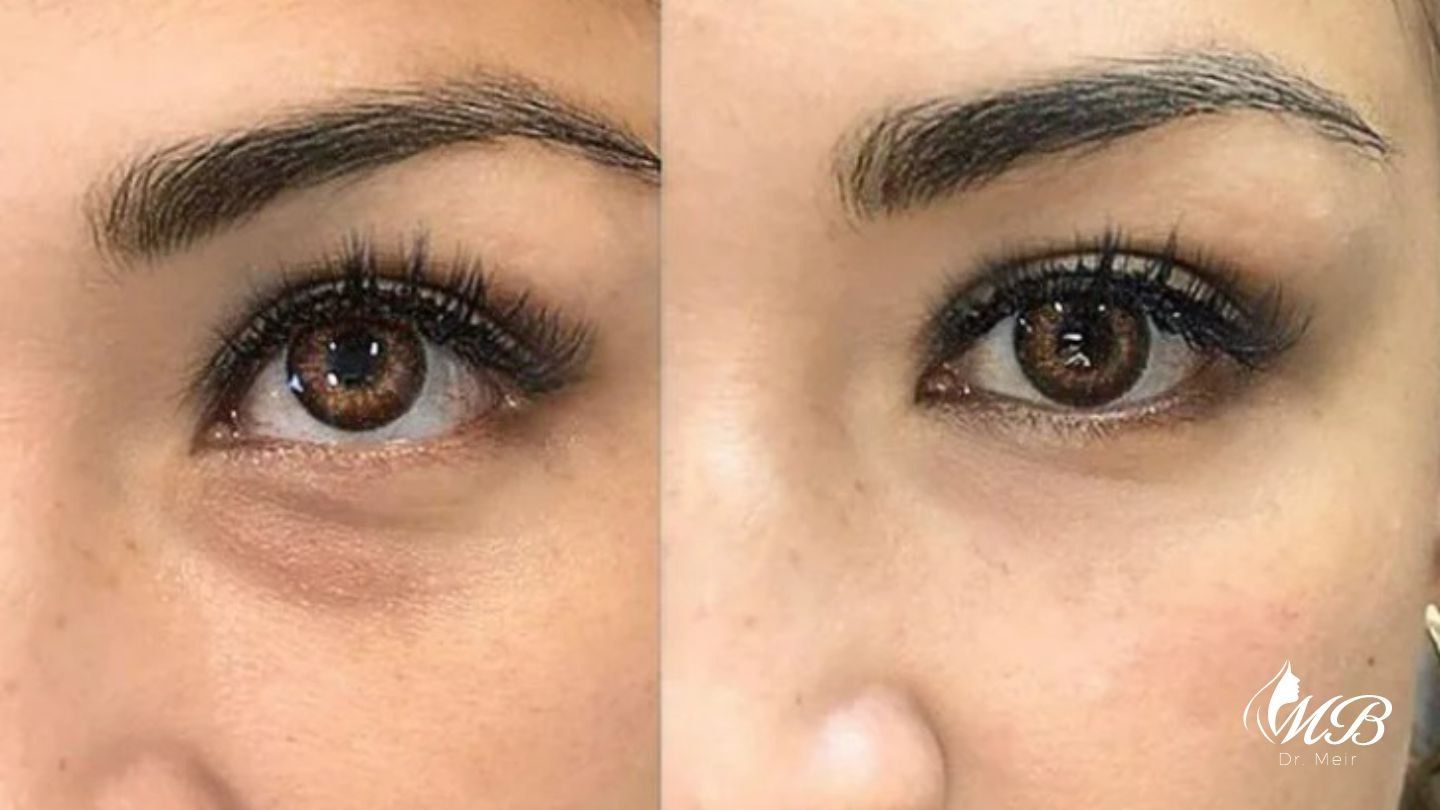
What under-eye filler treats
With age, the fat pad under the eye and on the upper cheek shrinks and drops. A groove forms between the lower eyelid and the cheek, called the tear trough. Light from above casts a shadow into it, and the eyes look tired even after a good night’s sleep.
Under-eye filler places a small amount of soft hyaluronic acid deep in that groove, close to the bone. It smooths the step between the eyelid and the cheek, so the shadow fades. The features do not change. You look rested.
A quick test at home: look in a mirror under overhead light and lift the skin of your cheek gently upwards with a finger. If the darkness disappears, it is mostly a shadow from a hollow, and filler may help. If the brown or bluish colour stays, filler will not remove it.
Who is a good candidate
- a visible tear trough with good bone support
- little or no fat bulging from the lower lid
- skin of reasonable thickness, not crepey or translucent
- no tendency to morning puffiness or fluid retention
- realistic expectations: a softer groove and a fresher look
Younger patients with an inherited hollow often have the clearest result. Older patients may still benefit, but often need skin tightening first.
Who is not a candidate
Under-eye filler has a narrow window, and Dr. Meir turns down a filler when it would make the area look worse. These are the main cases:
Festoons and malar bags. These are swellings of trapped lymph fluid and lax tissue sitting on the cheekbone, below the classic eye bags. Hyaluronic acid draws water into the tissue, so in an area that already holds fluid it can make the swelling bigger. Eyelid surgery for fat bags does not reach festoons either. RF microneedling with Morpheus8 is one option to tighten the tissue over a series of sessions.
Large fat bags. When fat bulges forward from the lower eyelid, filling the groove below it makes the whole area look heavier. Lower eyelid surgery addresses the fat itself. Dr. Meir refers to an eyelid surgeon when that is the right answer.
Very puffy eyes and morning swelling. Puffiness that changes through the day points to fluid. Filler adds to it.
Significant loose skin or a lax lower lid. Filler adds volume under skin that cannot hold it.
Very thin, translucent skin. Gel can show through as a bluish tint, the Tyndall effect.
Dark circles from pigment or vessels. Filler fills a hollow. It cannot change the colour of the skin.
Dark circles: several causes, several protocols
Dark circles under the eyes have more than one cause, and many people have two or three at once:
- Pigment: brown, even colour that stays when you stretch the skin. Common in medium and darker skin types.
- Vessels: bluish or purple tint where thin skin shows the veins beneath.
- Shadow: a hollow tear trough. This is where filler fits.
- Texture: fine lines and crepey skin that catch light unevenly.
Each cause has its own options. Depending on the case, the plan may include lightening creams, peels, mesotherapy, the TORO Q-switched laser for pigment, a vascular laser, RF microneedling for texture, or filler for the hollow. These are options among several, and Dr. Meir builds the combination after the examination. A single treatment for a mixed problem usually leaves part of it untreated.
How the treatment is done at the clinic
- Examination in good light, at rest and with the head tilted, to separate a hollow from fat bags, festoons, pigment and vessels.
- Planning the order. When there are also mild bags or loose skin, Dr. Meir tightens first, often with Endolift, and fills the groove only at the end, once the skin is firmer.
- Numbing cream on the skin.
- Injection with a blunt cannula through one small entry point. The gel is placed deep, on the bone, slowly and in small amounts. A cannula lowers the risk of entering a vessel in this area.
The amount is small, often well under one syringe for both sides. The gel is chosen for each patient: a soft product that draws in little water and does not form ridges under thin skin.
Note: If you already have lumps or sausage-shaped swellings from an earlier under-eye filler, they are dissolved with hyaluronidase first. A new filler is considered only after that.
Recovery
Mild swelling for two to three days is common. Bruising can appear and fades within about a week. Sleep with your head slightly raised for the first nights, skip hard exercise for a day or two and avoid rubbing the area.
Risks and side effects
Common: swelling, bruising, tenderness and slight unevenness in the first days. Less common: a lump, a bluish tint from shallow gel, or swelling that lasts weeks. Each of these is treated by dissolving the gel with hyaluronidase.
The serious and rare risk is gel entering a vessel. Around the eye, this can affect vision. Any change in vision, strong pain or skin turning pale after the injection needs immediate medical attention. A cannula, deep placement and small volumes reduce this risk, and the clinic keeps hyaluronidase on hand.
Results and timeline
The groove looks smoother straight away. After about two weeks the swelling has settled and you see the final result. At the follow-up, a small top-up is done if one side needs it.
Because the area moves little, the gel breaks down slowly. Results usually last one to two years, and studies have followed improvement up to 18 months.
How to choose
Choose a doctor who first tells you which kind of darkness or bag you have, and says no when filler is the wrong tool. Ask whether a cannula is used, how much gel is planned and what happens if a lump forms.
Consultations at the clinic in Holon are held in Hebrew, English and Russian. You can write in English on WhatsApp to 053-566-2287.
Results from the clinic
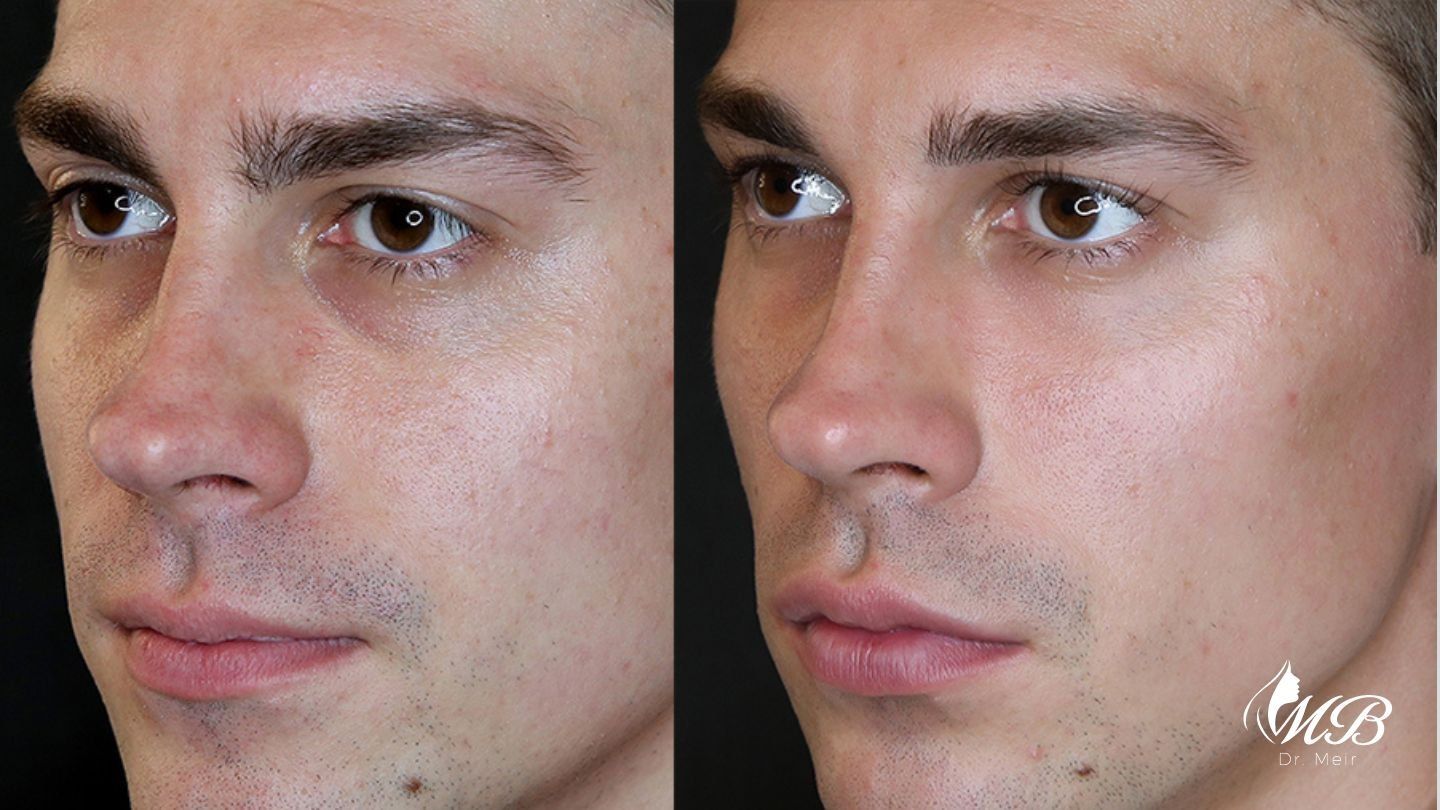
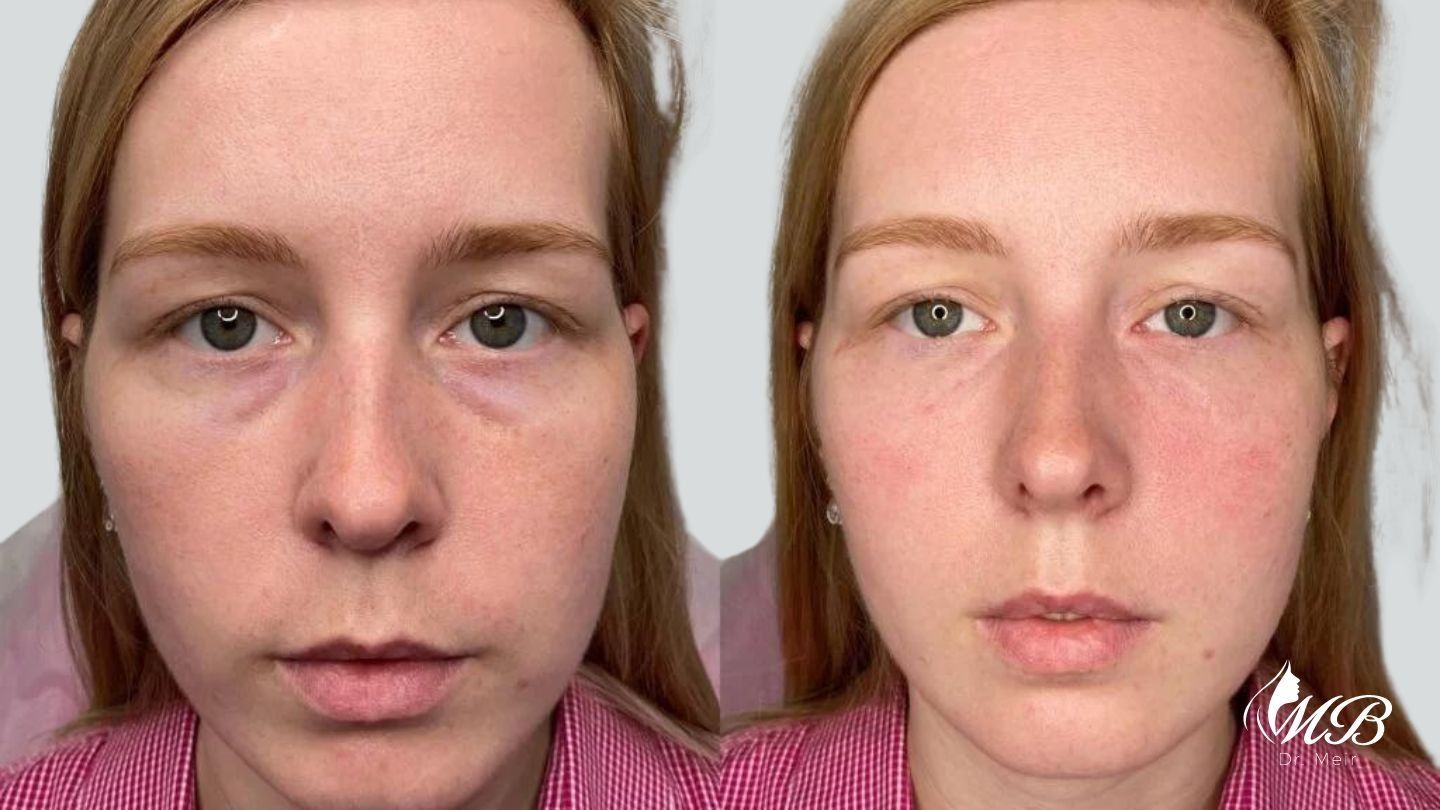
Individual results vary. Photos published with patient consent.
Price
| Hyaluronic acid filler, one syringe | ₪1,500–2,000 |
The final price depends on the extent of treatment and is given at the consultation.
Questions
Does under-eye filler remove dark circles?
Only the dark circles caused by a shadow from a hollow. Brown pigment and visible blue vessels need other treatments, and filler can make them look worse.
Can filler fix eye bags?
Small bags with a hollow below them can look better. Large fat bags, festoons and morning puffiness usually look worse after filler, because hyaluronic acid draws in water.
How long does tear trough filler last?
Usually one to two years. The area moves little, so the gel breaks down slowly.
What is the Tyndall effect?
A bluish tint when filler sits too close to the surface under thin skin. It is treated by dissolving the gel with hyaluronidase.
What are festoons?
Swellings of fluid and lax tissue that sit on the cheekbone, lower than classic eye bags. Filler and eyelid surgery rarely help them. RF microneedling is one option.
Is under-eye filler safe?
Serious complications are rare. A blunt cannula, a small volume and slow injection reduce the risk, and hyaluronic acid can be dissolved if needed.
Related
Sources: Expert recommendations on the use of hyaluronic acid filler for tear trough rejuvenation (PubMed); Optimizing infraorbital hollows treatment with hyaluronic acid fillers: anatomy, technique and products (PMC)