
What vascular laser treats
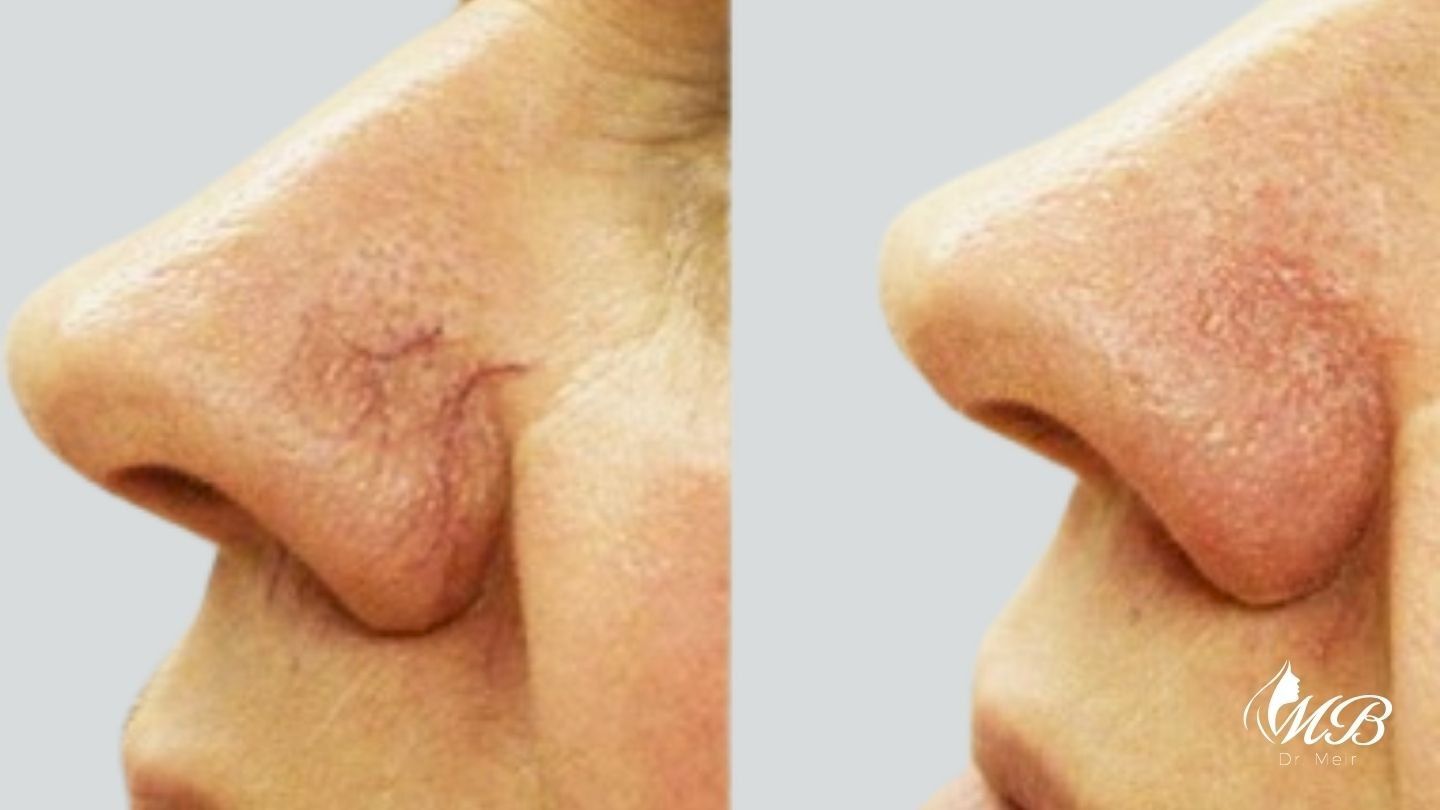
Spider veins (telangiectasia) are dilated small blood vessels, 0.1 to 1 mm wide, seen through the skin as red, purple or blue lines. On the face they gather on the cheeks, the sides of the nose and the chin. The European term couperose describes chronic facial redness with permanent fine vessels, which overlaps with the redness type of rosacea.
VBeam is a pulsed dye laser by Candela that emits yellow light at 595 nm. Haemoglobin inside the vessel absorbs this light far more than the melanin in the surrounding skin. The energy turns into heat in the vessel wall, the vessel collapses, and the body clears it over the following weeks. A cooling system protects the surface, so the skin is not wounded.
At the clinic, VBeam is used for:
- broken capillaries on the cheeks and nose
- redness and visible vessels in rosacea
- cherry angiomas (small red spots on the body)
- port-wine stains
- red marks left after acne or after removal of a skin lesion
VBeam is one of several vessel tools at the clinic. The Aerolase Neo Elite, a 1064 nm laser with a very short pulse, and the Lumenis M22 IPL also close fine vessels and reduce redness, and the clinic’s records show both in heavy use. The 1064 nm wavelength reaches deeper, bluish vessels and is the safer choice on olive and darker skin. The M22 suits diffuse redness mixed with sun damage on fair skin.
Who it suits and when to wait
Vascular laser suits adults with visible facial vessels or red spots that bother them. Treatment waits during a fresh tan, an active cold sore or an infection in the area. Pregnancy, blood-thinning medication and a tendency to bruise are discussed at the consultation.
Not every red spot is a simple vessel. A pearly bump with fine branching vessels can be a basal cell carcinoma, and laser would hide the vessels while the growth stays under the skin. Mat-like vessels on the face and hands can belong to an autoimmune condition. Dr. Meir examines each lesion, sometimes with dermoscopy, before he treats.
Facial capillaries and rosacea
For capillaries on the cheeks, Dr. Meir usually recommends a series of three laser sessions, one a month. Single vessels on the nose sometimes respond to one session. The clinic works with several vessel lasers, among them the Aerolase and the M22, chosen by vessel size and skin type. All visible capillaries are treated in the same session, without splitting the face.
Rosacea redness has several causes at once: dilated vessels, inflammation in the skin and sometimes pigment. A laser for vessels deals only with the vessels, so for facial redness the clinic does not rely on a pulsed dye laser alone. Dr. Meir combines the Aerolase laser to reduce redness and inflammation, the M22 IPL, and NeoGen plasma to improve skin quality, usually in a series of five sessions every two weeks. VBeam joins for single prominent vessels, and prescription creams or tablets treat the inflammation. When there is also pigment, a pigment laser joins the plan.
Trigger control matters as much as the device: sun, heat, alcohol, spicy food and hot drinks bring the redness back. Daily SPF is part of the treatment.
Two situations where VBeam is the wrong tool: poikiloderma of the neck, where the main problem is pigment and a pigment laser works better, and dark circles under the eyes, which VBeam does not improve.
Cherry angiomas
Cherry angiomas are harmless red spots that appear on the trunk and arms with age. Dr. Meir gives laser pulses until the lesion turns grey, which shows that the vessel has been sealed, and stops at that point. He then waits a month for the body to clear the remains before deciding whether a touch-up is needed. Do not try to remove an angioma at home, since it can bleed, become infected and scar.
Port-wine stains
A port-wine stain is a birthmark made of dilated capillaries. It is flat and pink in childhood and, in many people, darkens towards red-purple and thickens with age. Blebs, small raised bumps, can form on an older stain.
A port-wine stain is hard to treat. Laser can lighten it to some degree, after a long series of around ten sessions, and full clearance is not expected. Blebs on the stain can be treated separately with a vessel laser under local anaesthesia. Published studies show better clearing when treatment starts in infancy. A baby with a stain on the forehead and upper eyelid needs a medical assessment, including an eye check, because of a rare link with Sturge-Weber syndrome. Dr. Meir asks to see a clear photo of the stain before planning a series.
Spider veins on the legs: sclerotherapy
For spider veins on the legs, sclerotherapy is the standard treatment, and it works better there than VBeam. A fine needle injects a sclerosing solution into the vein. The vein wall closes, and the body absorbs the vessel gradually. First changes show after three to six weeks, and the best result after two to three months. Several sessions may be needed.
After sclerotherapy:
- wear compression as instructed for the first days
- avoid hot baths and saunas for 48 hours
- avoid long flights and heavy aerobic exercise for five to seven days
- protect the treated skin from the sun for several weeks
Large, bulging varicose veins, leg swelling, pain or skin changes on the shin are a different problem. They need a vascular assessment with ultrasound before any cosmetic treatment.
Hands. Bulging veins on the back of the hand can be softened with sclerotherapy or masked with volume from a filler. The choice depends on vein size and the thickness of the skin. Before destroying hand veins, people with kidney disease or who may need long-term infusions should consult their doctor, because those veins may be needed for access.
Recovery and side effects
After VBeam, treated vessels look like fine red scratches, and this passes within a few days. Mild swelling and redness are common for a day or two. At stronger settings, purple bruising can appear and fade over one to two weeks. Most patients go back to work the same day.
Side effects of sclerotherapy include bruising, brown staining along the vein, which fades in most patients within 6 to 12 months, and a fine network of new red vessels near the injection site (matting), which usually settles. Inflammation of the closed vein is uncommon. Ulceration and allergic reaction are rare.
Note: Sudden severe pain, a pale or bluish area at an injection site, swelling of the whole limb or a fever after sclerotherapy needs medical review the same day.
Results and timeline
Facial vessels fade over the weeks after each session, and the result builds across the series. Dr. Meir speaks of gradual improvement, because the skin forms new vessels over time, especially with sun, heat and rosacea. When new vessels appear, they can be treated as they come.
How to choose
Ask the doctor to separate vessels from pigment and from other red lesions before treatment, and to match the method to the site: laser for fine vessels on the face, sclerotherapy for the legs. The consultation is available in English, Russian and Hebrew at the clinic in Holon.
Results from the clinic
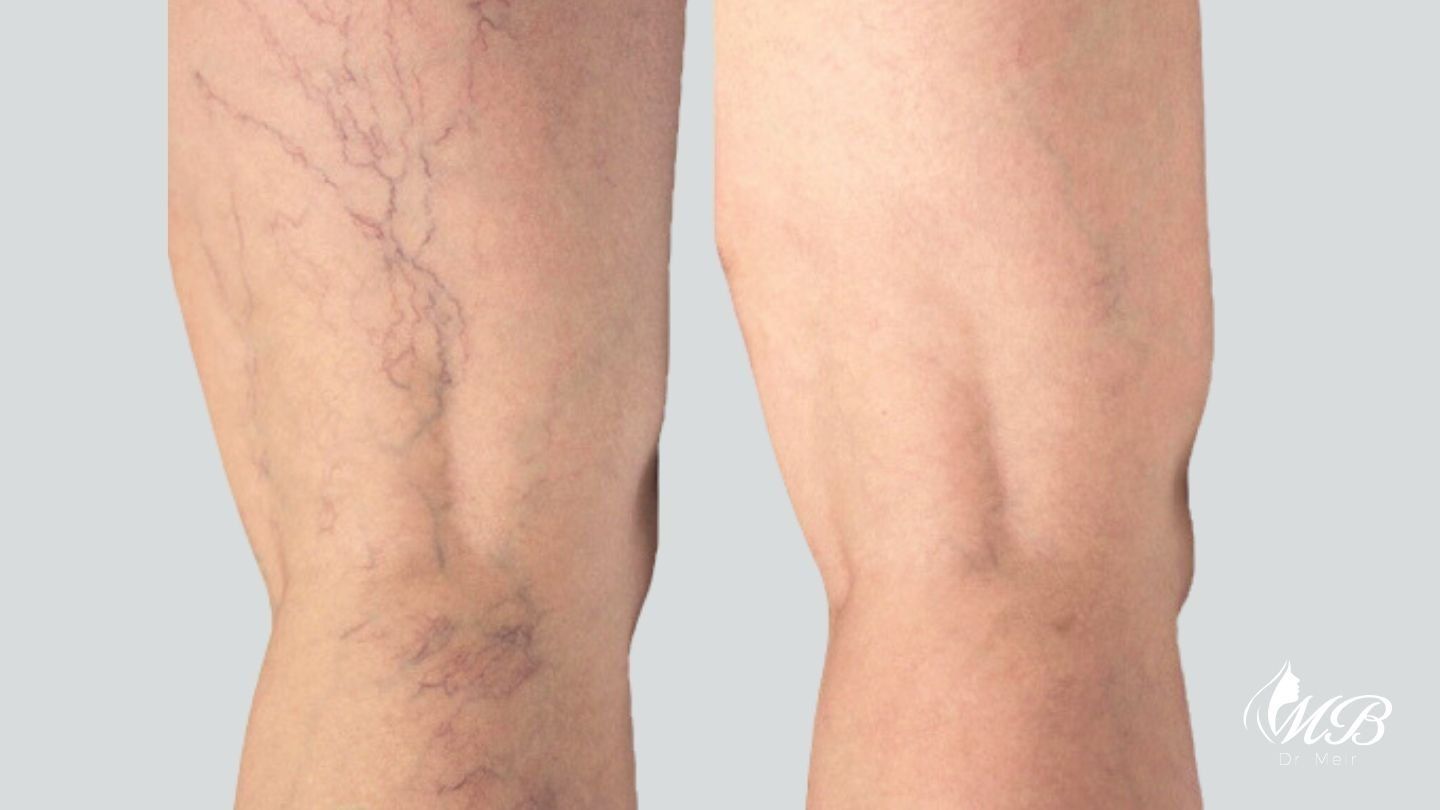
Individual results vary. Photos published with patient consent.
Questions
How many laser sessions do facial capillaries need?
Usually a series of three sessions, one a month. Single vessels on the nose sometimes clear after one session.
Does vascular laser hurt?
Most patients describe a quick snap on the skin. A cooling system protects the surface, and a session takes about 15 minutes.
Is laser or sclerotherapy better for leg spider veins?
Sclerotherapy is the standard treatment for spider veins on the legs. VBeam works best on fine vessels of the face.
Can laser cure rosacea?
No. Laser reduces the visible vessels and the redness, while the tendency stays. Most patients combine it with prescription treatment and trigger control.
Can a port-wine stain be removed with laser?
It can be lightened to some degree, after a long series of around ten sessions. Full clearance is not expected.
Do cherry angiomas come back?
A treated angioma usually stays gone, though new ones often appear with age and can be treated when they do.
Related
Sources: DermNet: Telangiectasia; DermNet: Sclerotherapy; DermNet: Cherry angioma