
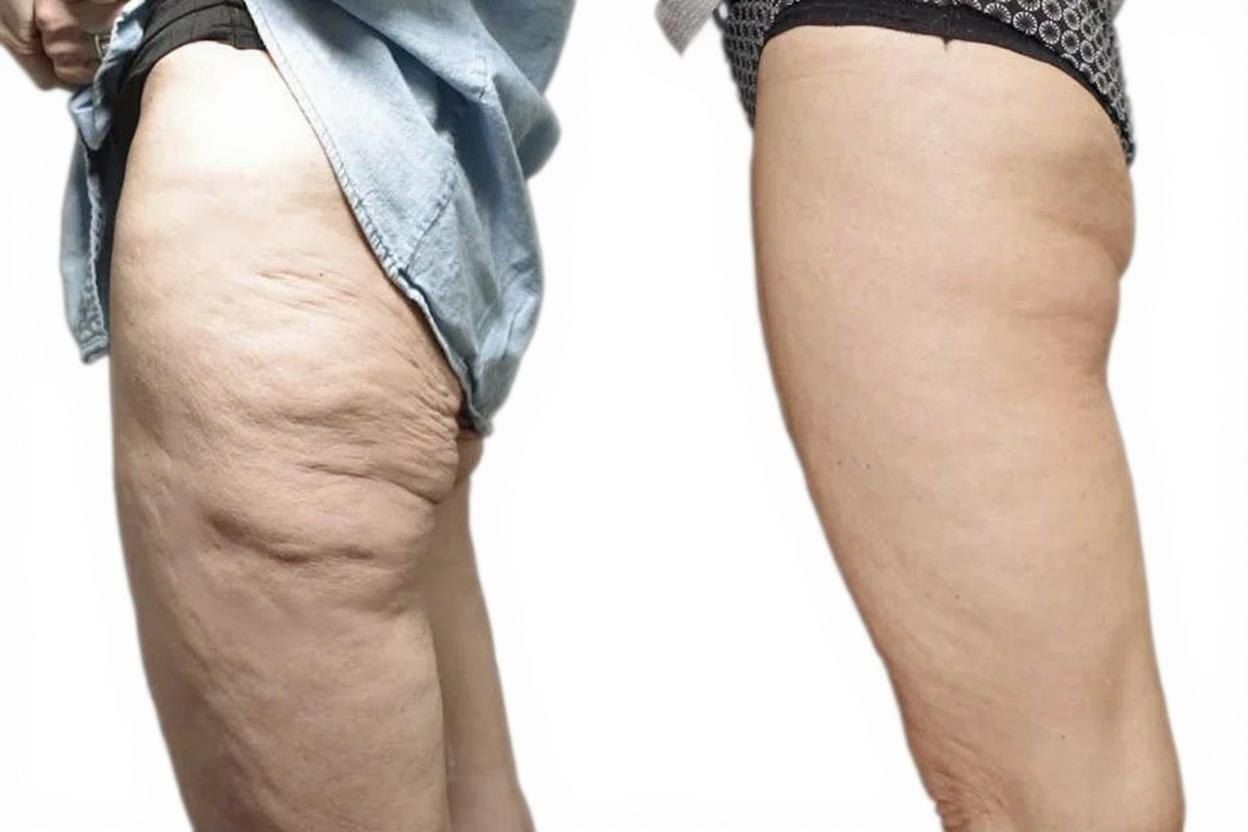
What cellulite is
Cellulite is the dimpled, uneven surface that most adult women notice on the thighs, buttocks, hips and sometimes the belly and upper arms. It is a normal feature of female skin and carries no health risk.
Under the skin run fibrous bands called septa. They tie the skin to the deeper tissue. In women these bands run straight down, like the ropes of a tent, and the fat between them bulges upward. Each band that pulls tight makes a small dimple, and the fat around it makes a small mound. In men the bands cross diagonally and spread the pull, so men rarely have cellulite.
Other factors make it more or less visible:
- Uneven distribution of superficial fat, mostly on the thighs and buttocks.
- Thinner skin and weaker collagen with age.
- Slower blood and lymph flow in the tissue.
- Hormones, especially oestrogen, and genes.
This explains why diets disappoint. You can reach your target weight and keep the dimples, because the bands do not move when the fat shrinks.
How severe is it
Doctors grade cellulite by what shows standing and lying down. The common Nürnberger-Müller scale has four grades:
- Grade 0: smooth even when you pinch the skin.
- Grade 1: smooth standing, dimples appear when you pinch.
- Grade 2: dimples visible standing, gone lying down.
- Grade 3: deep dimples standing and lying, sometimes with bulges.
The grade often differs between areas on the same person. The back of the thigh and the buttock tend to have deeper dimples, while the front of the thigh usually shows a mild, even texture. Dr. Meir grades each area separately and photographs it at the start, so later change can be measured.
What does not work, or works for days
Creams with caffeine or retinol improve the look of the surface for a short time. Massage, rollers and suction devices move fluid and smooth the skin for a day or two, then the look returns. Anything that works only on the surface needs buying again and again, with no change to the structure beneath.
Exercise helps in a different way. It thins the fat layer and firms the muscle underneath, which makes the area look tighter. It does not release the bands.
Fat freezing and external laser fat reduction are, in Dr. Meir’s experience, mostly ineffective, and the clinic does not rely on them for cellulite. An injectable enzyme for buttock cellulite, collagenase (QWO), was approved in the United States and withdrawn by its maker in 2023 after problems with extensive bruising and lasting skin discoloration.
How cellulite is treated at the clinic
Subcision for deep dimples
Subcision releases the bands that pull each dimple in. Dr. Meir marks every dimple with you standing, because many of them flatten when you lie down and could be missed on the table. The area is numbed with local anaesthetic. Through a tiny puncture he passes a Nokor needle, a fine needle with a small cutting tip, under the skin and cuts the bands beneath each mark. The skin above is freed and lifts back up.
At the clinic subcision is done without injecting diluted calcium hydroxylapatite filler into the released spaces. Treatment usually takes one session per area, and a touch-up of single dimples can follow once the tissue has settled.
Sculptra for skin quality
Sculptra (poly-L-lactic acid) is a biostimulator. Injected in a high dilution, it makes the skin produce new collagen over the following weeks, so thin, crepey skin over cellulite becomes thicker and smoother. It works across an area, which subcision does not. A series usually has two or three sessions a few weeks apart.
INDIBA radiofrequency
INDIBA warms the tissue with radiofrequency, improving circulation and stimulating collagen. It improves skin texture in mild cellulite and helps the tissue recover after subcision. It needs a series and maintenance, with no downtime.
Emerald laser for the fat layer
When a thicker fat layer adds to the uneven look, the Emerald low-level laser can trim circumference in a series of short sessions with no downtime. The change is modest and works on volume. It does not release dimples. For a larger volume of fat, liposuction is the more effective tool, combined with dimple treatment if cellulite is also present.
Note: Cellulite and excess fat are separate problems. Liposuction reshapes volume. Subcision and collagen treatments reshape the surface. A plan that mixes them up disappoints.
Recovery after subcision
Expect bruising and swelling for one to three weeks and tenderness when you sit or press the area. Most people return to office work the next day or two. A compression garment for a period after the procedure helps the skin settle onto the released tissue. Avoid intensive training for about a week.
Risks and side effects
Bruising is expected. Less common effects are small hard lumps under the skin, which soften over weeks, temporary darkening of the skin over the treated area, uneven correction where some dimples need a second pass, and, rarely, infection. Treatment is postponed during pregnancy, with active skin infection in the area or with a bleeding disorder. Tell the doctor about blood thinners in advance.
Results and timeline
The first change after subcision shows when the bruises fade, after two to three weeks. The final result settles over about three months. Sculptra and INDIBA build gradually across their series.
A realistic goal is a smoother surface with fewer and shallower dimples, especially in grades 2 and 3. A completely smooth thigh is not a realistic promise, and Dr. Meir does not make it.
When to see a doctor
Book an assessment when dimples on the thighs, buttocks or belly bother you despite an active lifestyle, or when the skin changed quickly. Bring a list of treatments you have tried and how each one worked. A first assessment can start from clear photographs on WhatsApp, taken standing in side light, which shows the dimples best.
Questions
Why do slim women get cellulite?
Cellulite depends on the structure of the bands under the skin more than on weight. In women these bands run straight up and down, so each one pulls a small dimple. In men they cross diagonally, which is why men rarely have it.
Will losing weight get rid of cellulite?
It may make it milder by thinning the fat layer, but the bands that pull the skin stay. Many women reach their target weight and keep the dimples.
Do anti-cellulite creams work?
Creams with caffeine or retinol can improve the look of the surface for a short time. They do not reach the bands that cause the dimples, so the effect fades when you stop.
Is subcision painful?
The area is numbed with local anaesthetic, so you feel pressure and movement. It is sore and bruised for one to three weeks afterwards.
Does liposuction remove cellulite?
No. Liposuction reduces volume. Cellulite sits in a more superficial layer, and aggressive liposuction under loose skin can make dimples more visible.
Will the cellulite come back?
Released bands rarely reform in the same place, but new dimples can appear with age, weight gain and loss of skin quality. Keeping a stable weight and active muscles protects the result.
Related
Sources: American Academy of Dermatology: Cellulite treatments, what really works?; Collagenase Clostridium histolyticum for the treatment of cellulite in the buttocks and thigh: early insights from clinical practice (PMC)