
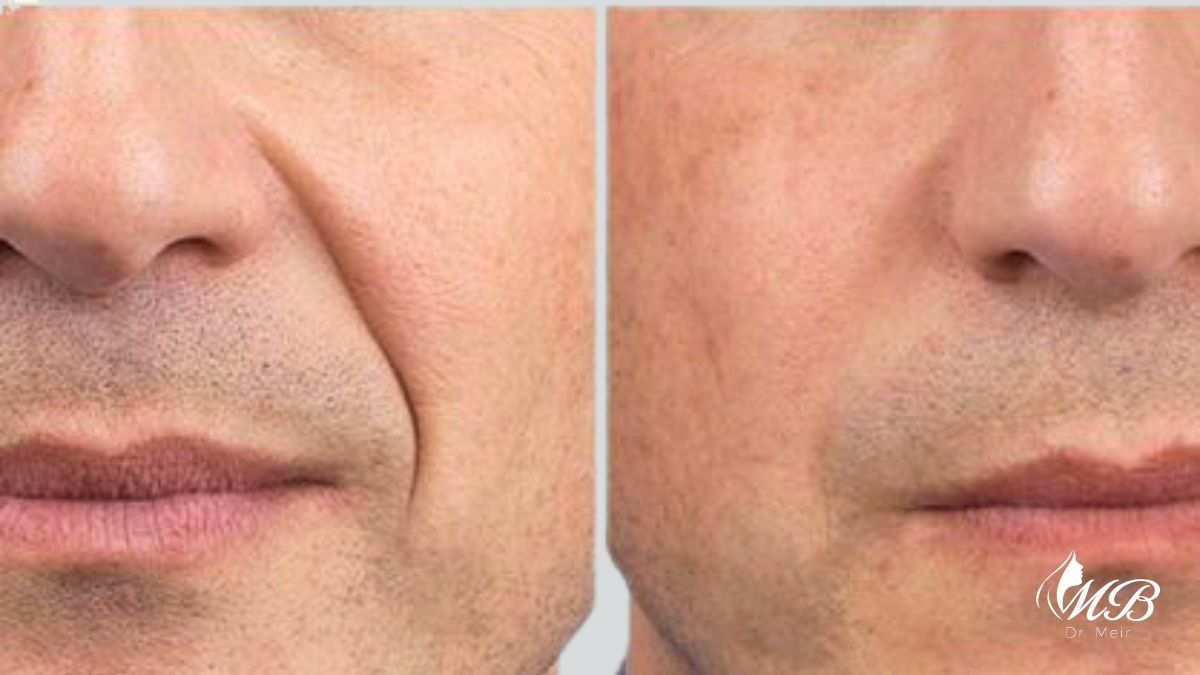
What nasolabial folds are
Nasolabial folds, often called smile or laugh lines, run from the sides of the nose to the corners of the mouth. Everyone has them. A young face shows a soft line when smiling. With age the line stays at rest and deepens, and the face can look tired or sad.
Marionette lines are a related pattern. They run from the corners of the mouth down toward the chin and often appear in the late forties and fifties, together with early jowls.
Why they form
The fold is the border between the cheek and the upper lip. What makes it deeper happens mostly above and around it:
- Midface volume loss. The fat pads of the cheek shrink and slide down with age. The tissue that used to sit on the cheekbone now rests against the fold.
- Bone changes. The bone around the upper jaw and the opening of the nose recedes over the years, so the base under the fold loses support.
- Skin quality. Collagen loss and sun damage make the skin thinner and less elastic.
- Muscle action and habits. Smiling, sleeping on one side, smoking and rapid weight loss add to it. Weight loss with GLP-1 medicines such as Ozempic often makes the folds appear deeper within months.
This is why the fold is mainly a volume problem and only partly a wrinkle.
Why filling only the fold looks unnatural
The most common approach is to inject filler straight into the fold. In a mild fold this works well. In a deep fold with a sagging cheek it often does not. Filler placed only in the line adds weight to the lower face while the cause above stays untreated. The result can look heavy, and the area can bulge when smiling.
Dr. Meir starts by looking at the face from the front and the side, at rest and when smiling. When the cheek has lost volume, he often restores support in the midface first. Lifting the cheek tissue from above shortens and softens the fold, and then a small amount along the fold finishes the correction if it is still needed. The total amount of filler is often lower than when the fold alone is filled.
Note: The filler product is chosen for each patient and each area, according to skin thickness, the depth of the fold and how much the area moves. There is no fixed product for the nasolabial fold.
Treatment options
Hyaluronic acid fillers
Hyaluronic acid is the first-line treatment for most folds. Firmer products give structure in the cheek, and softer ones suit the fold and the lines around the mouth. The effect shows at once. Hyaluronic acid can be dissolved with hyaluronidase if needed.
At the clinic the skin is numbed with cream, and most products contain lidocaine. Dr. Meir injects with a needle or a blunt cannula, depending on the area, and aspirates before injecting with a needle.
Biostimulators
Sculptra and Radiesse prompt the skin to build its own collagen over several months. They suit patients with general volume loss and thin skin, and they give a gradual result that can last longer than hyaluronic acid. They are planned as a course and are not used to fine-tune a single line.
RF microneedling and skin tightening
Morpheus8 improves skin quality and mild laxity in the lower face. It does not fill a fold, but it makes the skin around it firmer and smoother. Patients with early jowls sometimes combine it with filler.
Botox for the mouth corners
Botox is rarely injected into the nasolabial fold itself, because relaxing the lip-lifting muscles changes the smile. It is useful lower down: a small dose into the depressor anguli oris (DAO) muscle relaxes the pull that turns the corners of the mouth down. Marionette lines look softer and the mouth looks less sad. The effect lasts about 3 to 4 months.
Combined plan for marionette lines
Marionette lines usually need more than one tool: filler along the line and at the jaw to restore support, botox to the DAO, and sometimes skin tightening for early jowls.
Recovery and side effects
Most patients go back to work the same day. Swelling, tenderness and small bruises at the injection points are common and settle within days. Avoid strenuous exercise, sauna and massage of the area for the first 24 to 48 hours. Hard lumps are uncommon and usually soften with time or massage.
The most serious risk of filler is blocking a blood vessel, which can harm the skin. Signs include sudden pain, white or blotchy skin and later a dusky colour. The area near the nose has important vessels, so the injection technique and depth matter. Hyaluronidase is on hand at every filler session. Contact the clinic at once if you notice these signs.
Results and timeline
Hyaluronic acid shows at once and settles fully in about 2 weeks, when swelling has gone. It usually lasts about 6 to 12 months in this area. Biostimulators build up over 2 to 3 months and are often repeated after a year or two. Botox to the DAO lasts about 3 to 4 months.
The goal is a softer fold, not a flat cheek-to-lip line. A face without any fold looks artificial, especially when smiling.
How to choose a treatment
- Ask whether the cheek needs support before the fold is filled.
- Check that the doctor chooses the product for your face and does not use one filler for every area.
- Make sure the injector aspirates where needed and has hyaluronidase on hand.
- Prefer a plan that treats folds and marionette lines as part of the whole lower face.
Consultations at the clinic in Holon are held in English, Russian or Hebrew. A photo from the front and from the side, at rest and smiling, helps for a first assessment.
Results from the clinic
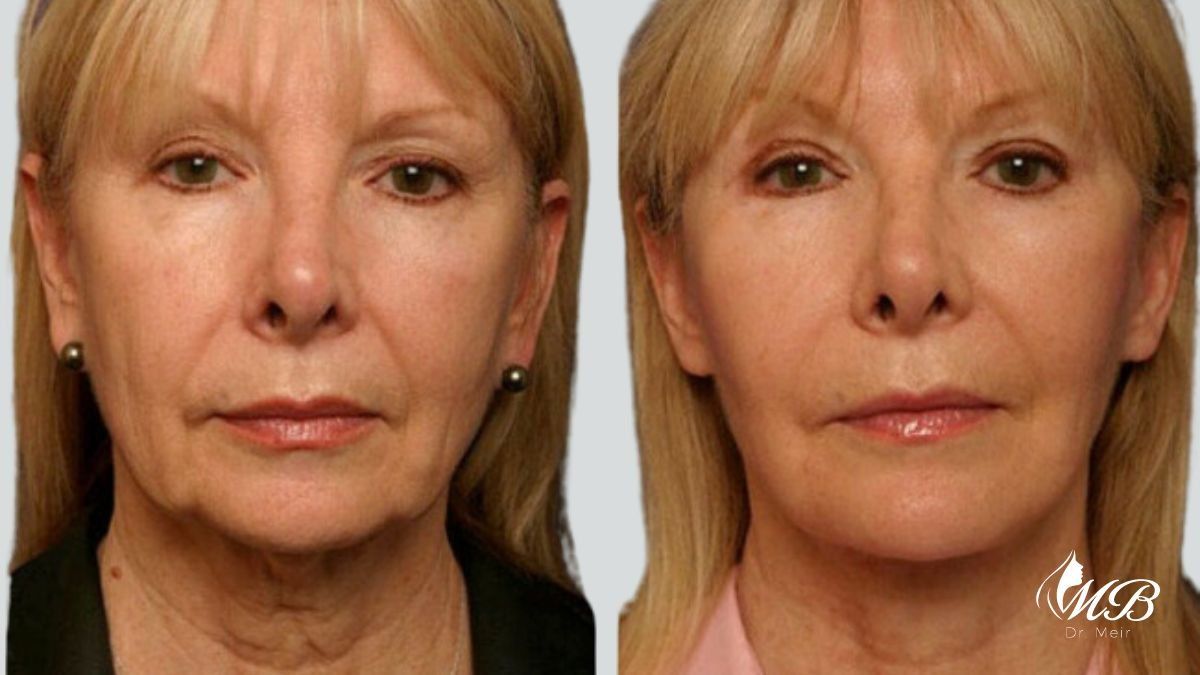
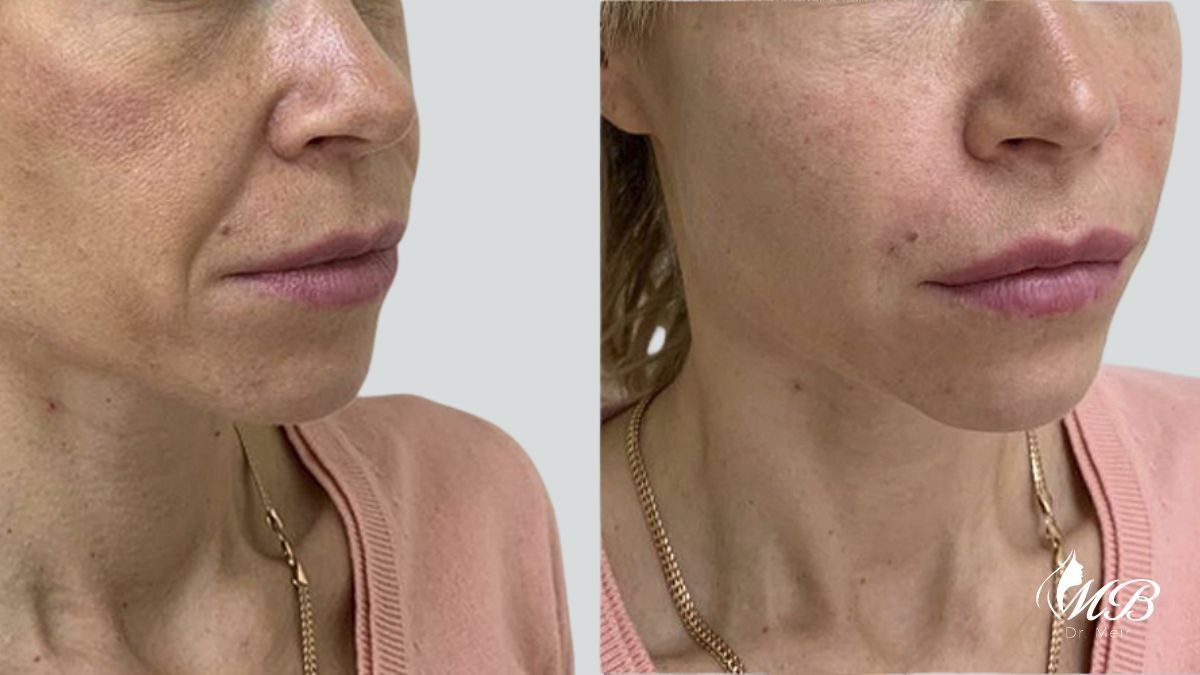
Individual results vary. Photos published with patient consent.
Price
| Hyaluronic acid filler, one syringe | ₪1,500–2,000 |
The final price depends on the extent of treatment and is given at the consultation.
Questions
What is the best treatment for nasolabial folds?
For most people, hyaluronic acid filler. When the cheek has lost volume, Dr. Meir often restores support in the cheek first, which softens the fold from above, and then adds a small amount along the fold if needed.
Why does filler in the folds sometimes look unnatural?
Filling a deep fold on its own while the cheek above keeps sagging adds weight to the lower face. The area can look puffy, especially when smiling. Treating the cause in the midface needs less product in the fold.
How long does nasolabial fold filler last?
Usually about 6 to 12 months, depending on the product, the amount and how much you move the area. Biostimulators build collagen that can hold longer.
Can botox treat nasolabial folds?
Botox is rarely used for the fold itself, because relaxing the lip-lifting muscles can change the smile. It is used for marionette lines, by relaxing the DAO muscle that pulls the mouth corners down.
What are marionette lines?
Lines that run down from the corners of the mouth toward the chin. They come from volume loss around the mouth and jaw and the pull of the DAO muscle. Filler along the line and botox to the DAO often work together.
Can nasolabial filler be dissolved?
Yes. Hyaluronic acid filler dissolves with hyaluronidase within days. The clinic keeps it on hand.
Related
Sources: FDA: Dermal fillers (soft tissue fillers); FDA: Dermal filler do's and don'ts for wrinkles, lips and more; American Academy of Dermatology: Fillers overview