
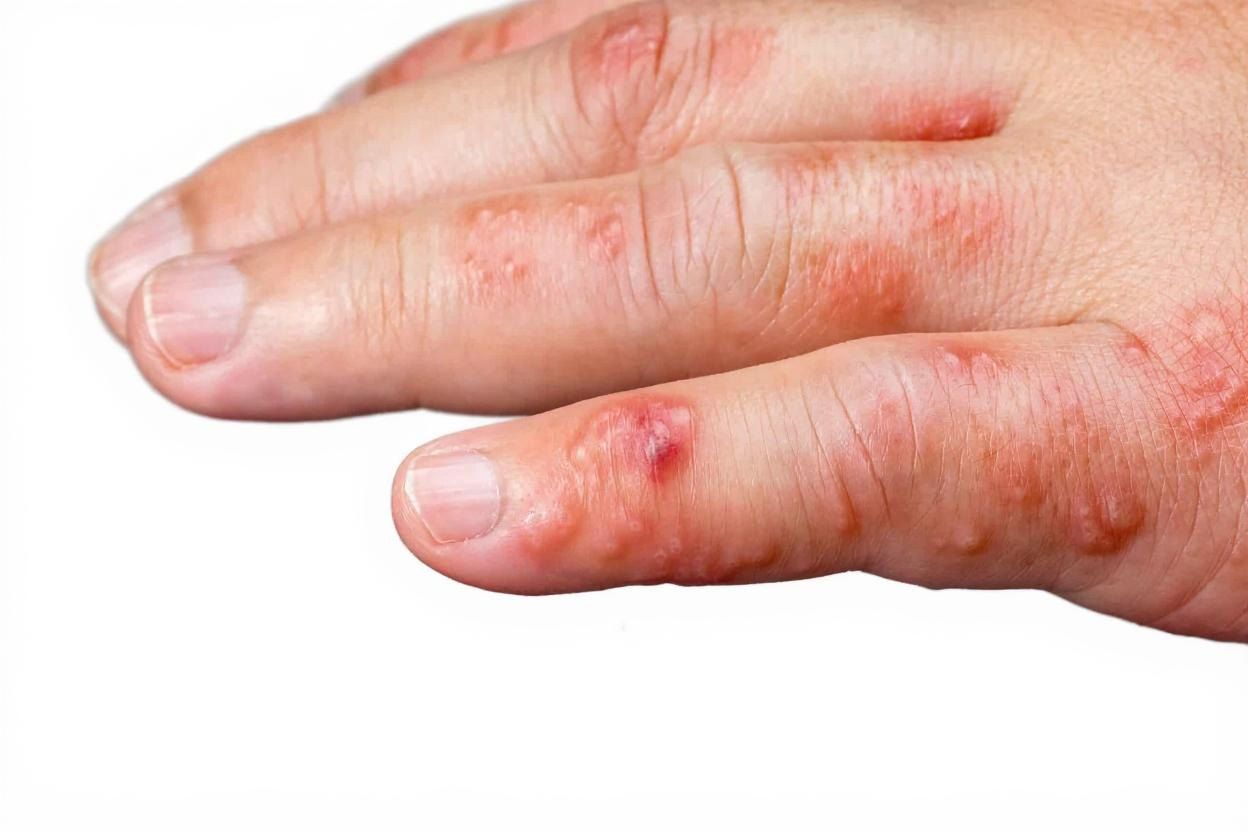
What scabies is
Scabies is a skin infestation by a microscopic mite, Sarcoptes scabiei. The female mite is about 0.3 to 0.4 mm long, too small to see. She digs a tunnel (burrow) in the top layer of the skin and lays one to three eggs a day for several weeks. The eggs hatch within two to three days and the new mites mature in about two weeks.
The rash and the itch come from the body’s allergic reaction to the mites, their eggs and their waste. In classic scabies a person carries only 10 to 15 adult mites on the whole body. That small number explains why a doctor sometimes has to search with a magnifier to find one.
How scabies spreads
Scabies passes through prolonged skin-to-skin contact: sharing a bed, sex, holding a baby, children playing together. A short handshake rarely passes it on. Shared towels, bedding and clothes can carry mites, but this route is less common, because a mite dies within two to three days away from human skin.
Scabies spreads easily in families, kindergartens, boarding schools, army units and care homes. When one person in a home has it, others usually follow.
The tricky part is the delay. After a first infection, itch starts only 2 to 6 weeks later. During that time the person passes mites to others without knowing. In a second infection the body recognises the mite, and itch starts within one to four days.
Symptoms
- Intense itch that gets worse at night, when the body warms up under a blanket
- Small red bumps, blisters or scratch marks
- Thin, wavy grey lines on the skin, a few millimetres long: the burrows
- Several family members itching at the same time
In adults and teenagers the rash sits between the fingers, on the wrists, elbows, armpits, waistline, buttocks, groin and genitals, and around the nipples in women. Itchy bumps on the penis or scrotum are typical of scabies. In babies and young children the rash also appears on the palms, soles, scalp, face and neck.
Scabies is often mistaken for eczema or an allergy. Two clues point to scabies: itch that flares at night, and other people at home who itch too.
Crusted (Norwegian) scabies
In older adults, people with a weak immune system and people with reduced sensation, scabies can turn into a severe form called crusted scabies. Thick, grey, flaking crusts form on the hands, feet, scalp or larger areas, and they hide thousands to millions of mites. Itch can be surprisingly mild. This form is highly contagious and needs urgent treatment that combines tablets and creams.
How scabies is diagnosed
The diagnosis starts with an examination of the skin and a search for burrows, often with a dermatoscope (a lighted magnifier). To confirm it, the doctor can gently scrape a burrow and look for mites, eggs or mite droppings under a microscope. A negative scraping does not rule scabies out, because there are so few mites. When the picture is typical and several family members itch, treatment starts on the clinical diagnosis.
At the clinic in Holon, Dr. Meir examines the skin, takes a microscope scraping when it helps, and gives one written plan for the whole household. Prescriptions for family members are arranged at the same visit where possible, so the household can start on the same day.
Treatment: kill the mites, then calm the itch
No over-the-counter product reliably kills scabies mites. Treatment needs a prescription.
Permethrin 5% cream
Permethrin 5% is the first-line treatment in most guidelines. How to use it:
- Apply after a lukewarm shower, on cool, dry skin.
- Cover the whole body from the neck down: between fingers and toes, under the nails, the soles, the genitals and the skin folds. In babies, young children and older adults, also treat the scalp, face, neck and ears, avoiding the eyes and mouth.
- Leave it on for 8 to 14 hours, usually overnight. Reapply to the hands after each hand wash.
- Wash it off in the morning.
- Repeat the full application after 7 days, to kill mites that hatched from eggs in between.
Oral ivermectin
Ivermectin is an antiparasitic tablet. The dose depends on body weight, and it is usually given as two doses about a week apart. Doctors use it for crusted scabies, outbreaks in institutions, when a cream fails, or when applying a cream to the whole body is not practical. In crusted scabies, ivermectin is given in several doses together with repeated permethrin and a cream that softens the crusts. Ivermectin is not usually given to children under 15 kg or in pregnancy.
Treat everyone at once
Everyone who lives in the home and every close or sexual contact from the last month applies the treatment on the same day, with or without itch. Treating only the person who itches is the most common reason scabies “comes back”.
Note: Most cases of “treatment failure” are reinfection from an untreated family member, a missed area such as the hands or the soles, or a skipped second application. Real resistance to permethrin is uncommon.
Clothes, bedding and the home
On the morning after the first application:
- Wash bedding, towels, pyjamas and clothes worn in the last three days at 60°C, and dry them in a hot dryer.
- Seal items you cannot wash, such as soft toys or shoes, in a plastic bag for 3 days.
- Vacuum mattresses, sofas and car seats.
Pesticide sprays on the body, the furniture or the home are not needed. Throwing away mattresses or clothes is not needed either.
Relief from the itch
While the treatment works: lukewarm baths, a moisturiser, calamine lotion and an antihistamine tablet at night. A short course of a prescription steroid cream can calm the rash once the mites are treated. Keep nails short, because scratching can lead to a bacterial infection.
Children, pregnancy and older adults
Permethrin 5% is the usual choice for babies from about two months of age, in pregnancy and while breastfeeding. Younger babies are treated under close medical guidance. In babies and young children the cream also covers the scalp and face, and mittens help stop them licking it off their hands.
In older adults living in a care home, crusted scabies must be considered when there are thick scales or several residents and staff itch. The whole institution then needs a coordinated plan.
Itch after treatment and when to come back
The itch fades slowly, because the allergic reaction continues after the mites have died. Itch for 2 to 4 weeks after a correct course is expected and does not mean the treatment failed. Repeating permethrin again and again for this itch only irritates the skin and can create eczema.
Some people, mostly children, develop firm, itchy brown-red nodules on the groin, armpits or buttocks. These nodules can last weeks to months after the mites are gone and respond to steroid creams.
Come back for a review if:
- new burrows or new spots appear more than two weeks after the second application
- the itch gets worse rather than better after four weeks
- the skin becomes painful, hot, or weeps pus (a sign of bacterial infection)
When to see a doctor
See a doctor when night-time itch lasts more than a week, when a rash appears between the fingers, on the wrists or in the groin, or when several people at home itch. Scabies does not clear on its own, and every week of delay adds more people to treat.
Consultations at the clinic in Holon are in Hebrew, English and Russian. The appointment covers diagnosis, a microscope check where needed, and a treatment plan for the patient and the household.
Questions
Can scabies go away on its own?
No. The mites keep laying eggs, and the rash spreads to other people in the home. Scabies needs a prescription scabicide.
Why am I still itching after scabies treatment?
The itch is an allergic reaction to dead mites and their debris, and it fades slowly. Itch for 2 to 4 weeks after a correct course is normal. New burrows or new spots after two weeks need a recheck.
Does the whole family need treatment?
Yes. Everyone in the household and close contacts apply the treatment on the same day, even without itch. Symptoms take 2 to 6 weeks to appear after a first infection, so people without itch may already carry mites.
How long can scabies mites live on bedding or a sofa?
Away from human skin a mite usually survives 2 to 3 days. Hot washing, a hot dryer, or sealing items in a bag for 3 days is enough. Spraying pesticides in the home is unnecessary.
Is permethrin safe for babies and in pregnancy?
Permethrin 5% is used in pregnancy, during breastfeeding and in babies from about 2 months of age. In babies and young children the cream also goes on the scalp, face and neck, avoiding the eyes and mouth.
When can a child go back to kindergarten?
Usually the day after the first full application of the cream, once the whole household has been treated.
Related
Sources: American Academy of Dermatology: Scabies diagnosis and treatment; NHS: Scabies; DermNet: Scabies