
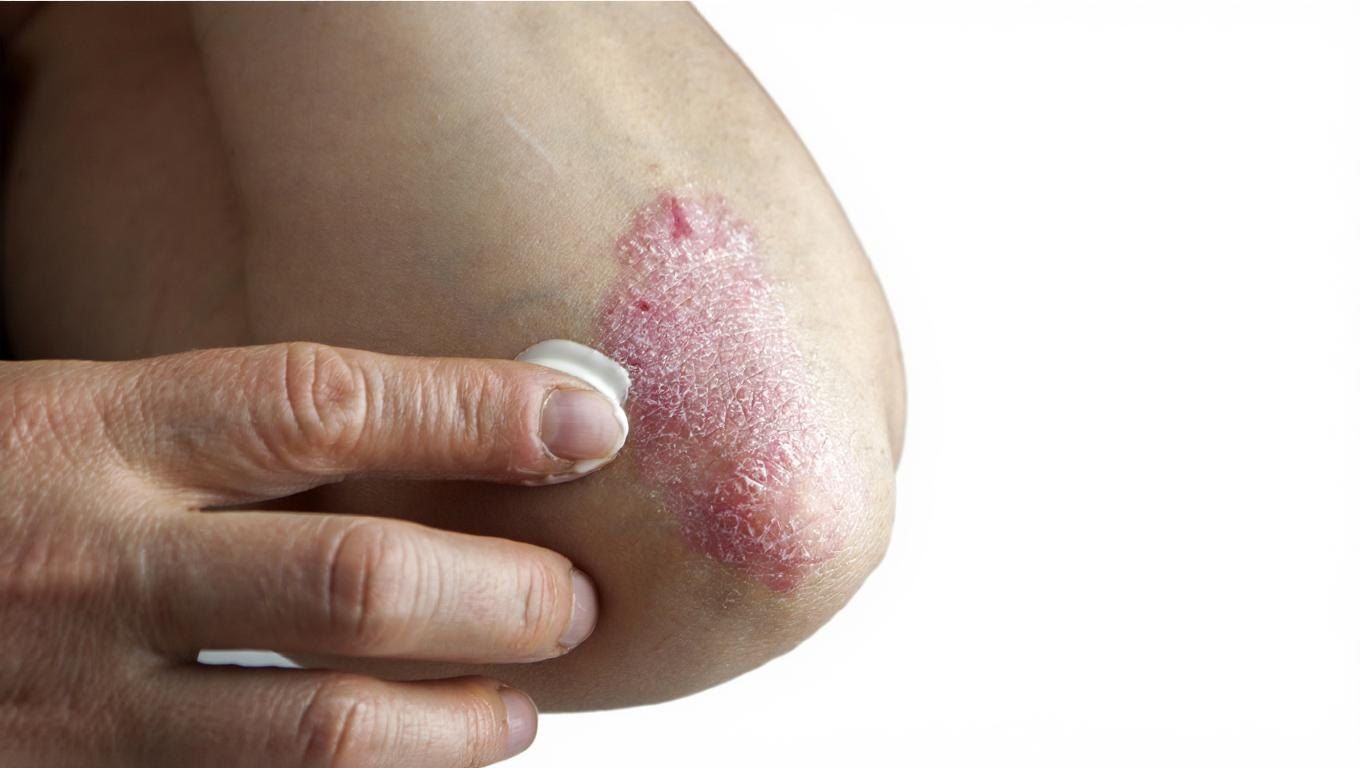
What psoriasis is
A healthy skin cell takes about a month to travel from the deep layer to the surface and shed. In psoriasis the immune system speeds this up to a few days. Cells pile up before they mature and form thick, raised, red plaques covered with silvery-white scale. Plaques can itch, hurt and crack.
Psoriasis is chronic and comes in waves: flares alternate with quieter periods. It runs in families, and it is not contagious and has nothing to do with hygiene.
Types of psoriasis
- Plaque psoriasis: the most common form, with raised red plaques and silvery scale on the elbows, knees, scalp and lower back.
- Guttate psoriasis: small drop-shaped spots, often in children and teenagers after a strep throat.
- Inverse psoriasis: smooth, shiny red patches in skin folds, such as the armpits, groin and under the breasts, without the typical scale. It is often mistaken for a fungal infection.
- Scalp psoriasis: thick scale that often extends past the hairline onto the forehead, neck and behind the ears.
- Nail psoriasis: tiny pits in the nail, yellow-brown discolouration and the nail lifting off its bed.
- Pustular and erythrodermic psoriasis: rare, severe forms that need urgent medical care.
Triggers
Genes set the tendency, and the environment sets when and how strongly it shows. Known triggers include infections (especially strep throat before guttate psoriasis), stress, skin injury and friction, cold dry weather, smoking, alcohol and some medicines, such as beta-blockers and lithium. Knowing your own triggers can reduce the number of flares before any medication starts.
More than skin
Psoriasis is a systemic inflammatory disease. Some patients develop psoriatic arthritis, with joint pain, swelling and stiffness that is worst in the morning or after rest, often in the fingers, toes, lower back or Achilles tendon. A whole swollen finger, a “sausage finger”, is typical. Nail changes often come before joint pain. Untreated joint inflammation can cause permanent damage, so persistent joint pain alongside skin psoriasis means a referral to a rheumatologist.
Psoriasis is also linked to higher rates of heart disease, diabetes and metabolic syndrome, inflammatory bowel disease and eye inflammation (uveitis), as well as anxiety and depression. Good care looks at blood pressure, weight and blood lipids too, and not only at the skin.
How psoriasis is diagnosed
The diagnosis is clinical: the look of the plaques, where they sit, the nails and the history. A biopsy is rarely needed. The main look-alikes are eczema, seborrheic dermatitis on the scalp and fungal infection in the folds.
| Feature | Psoriasis | Atopic eczema |
|---|---|---|
| Border | Sharp, well defined | Blurred |
| Scale | Silvery and thick | Fine, sometimes weeping |
| Typical sites | Elbows, knees, scalp | Inner elbows, behind knees, neck |
| Itch | Moderate | Intense |
The treatment ladder
Treatment is built in steps, according to severity and how much of the body is involved. Creams and foams come first. Phototherapy and systemic medicines follow when topical treatment is not enough.
Step 1: prescription topical treatment
Topical steroids are the backbone for limited plaques. For thick, stubborn plaques on the body, Dr. Meir uses clobetasol propionate 0.05%, sold as Dermovate. It is the strongest class of topical steroid (class I) and brings down inflammation and scale quickly. Because of that strength it follows clear rules:
- A thin layer once a day on the plaques only. One fingertip unit, a strip of cream from the fingertip to the first crease, weighs about half a gram and covers an area the size of two adult palms.
- Usually up to two weeks in a row, sometimes up to four weeks on thick plaques under supervision, and no more than 50 g a week.
- Not on the face, armpits, groin or skin folds, and not under a dressing, unless the doctor says so.
- Stopped gradually as directed, often by spacing applications or moving to a milder steroid, to avoid a rebound flare.
Long or excessive use thins the skin and causes stretch marks and visible small vessels. Over large areas the steroid can be absorbed into the body and suppress the body’s own cortisol production. That is why clobetasol is a short, targeted tool, not a daily routine.
Vitamin D analogues, such as calcipotriol, slow skin cell growth. They work alone or with a steroid, and the combination works better than either one alone. A ready-made gel combining calcipotriol with betamethasone (Daivobet) is used once a day, and vitamin D creams also help keep the skin clear after a flare with less steroid exposure.
Supporting treatments: salicylic acid lifts thick scale so other creams can penetrate, and daily moisturiser reduces cracking and itch.
Note: creams often “fail” because scale blocks them. On the scalp, softening scale overnight with oil and washing it out in the morning lets the steroid work. Skipping this step is a common reason patients think a treatment does not help.
Treatment by area
- Scalp: clobetasol foam, shampoo or solution for a few weeks, then calcipotriol with betamethasone gel for maintenance, and tar or salicylic acid shampoo to lift scale.
- Skin folds and face: these absorb steroids several times more than ordinary skin. A mild steroid for a short course, then tacrolimus (Protopic) or pimecrolimus (Elidel), which control inflammation without thinning the skin.
- Nails: creams penetrate the nail plate poorly. A single severely affected nail can be treated with steroid injections into the nail fold. Many affected nails, or nails with joint disease, point toward systemic treatment.
Step 2: phototherapy
When psoriasis covers a large area, controlled exposure to narrowband UVB light slows the immune reaction in the skin and clears plaques. It is given several times a week over a course at a phototherapy unit. The clinic does not run phototherapy and refers patients when it fits.
Step 3: tablets and biologics
For moderate to severe psoriasis, or when the joints are involved, systemic medicines are considered: methotrexate, ciclosporin and acitretin act on the whole body. Biologic medicines target the specific immune messengers that drive psoriasis (TNF, IL-17, IL-23) and are given by injection. Many patients on biologics reach clear or almost clear skin.
Systemic and biologic treatment needs screening tests before starting and regular monitoring. The clinic treats psoriasis with prescriptions and does not run biologic treatment itself. When a patient needs biologics or systemic therapy, Dr. Meir makes a referral to a specialist who runs this treatment and continues to help with topical care for the remaining plaques.
Results and timeline
A strong steroid usually calms plaques within one to two weeks. If there is no improvement after two weeks, the diagnosis and plan are reviewed. Vitamin D creams act more slowly, over several weeks. Phototherapy takes a course of weeks, and biologics usually show a clear effect within the first months. The goal is long calm periods with as little steroid as possible.
When to see a doctor
Book a visit when red, scaly plaques do not clear within two weeks, when itch or pain disturbs sleep or work, or when joint pain appears next to skin changes. Bring a list of your medications and notes on when flares happened. Dr. Meir has more than 20 years of experience and consults at the clinic in Holon in Hebrew, English and Russian. To book, message the clinic on WhatsApp at 053-566-2287.
Questions
Can psoriasis be cured completely?
No. Psoriasis is chronic and there is no cure today. Current treatment controls it well, and many patients keep clear or almost clear skin for long periods.
Is psoriasis contagious?
No. You cannot catch psoriasis by touch or shared objects. It is an immune reaction, not an infection.
How long can I use clobetasol (Dermovate)?
Usually no more than two weeks in a row, sometimes up to four weeks on thick plaques under a doctor's supervision, and no more than 50 g a week. It is then tapered and stopped as the doctor directs.
Can I put Dermovate on my face?
Not without explicit instruction from a doctor. The face, armpits, groin and skin folds absorb steroids faster and thin easily, so milder preparations are used there.
When are biologics considered?
When psoriasis is moderate to severe, affects quality of life or the joints, and has not responded well enough to creams and phototherapy. The clinic refers such patients to a specialist who runs biologic treatment.
Does psoriasis affect the joints?
In some patients. Psoriatic arthritis causes pain, morning stiffness and swelling, often in the fingers, toes, lower back or heel. Early assessment by a rheumatologist protects the joints.
Related
Sources: NHS: Psoriasis treatment; Psoriasis: Update on Topical Therapy From the American Academy of Dermatology. Am Fam Physician 2022; NICE CG153: Psoriasis, assessment and management