
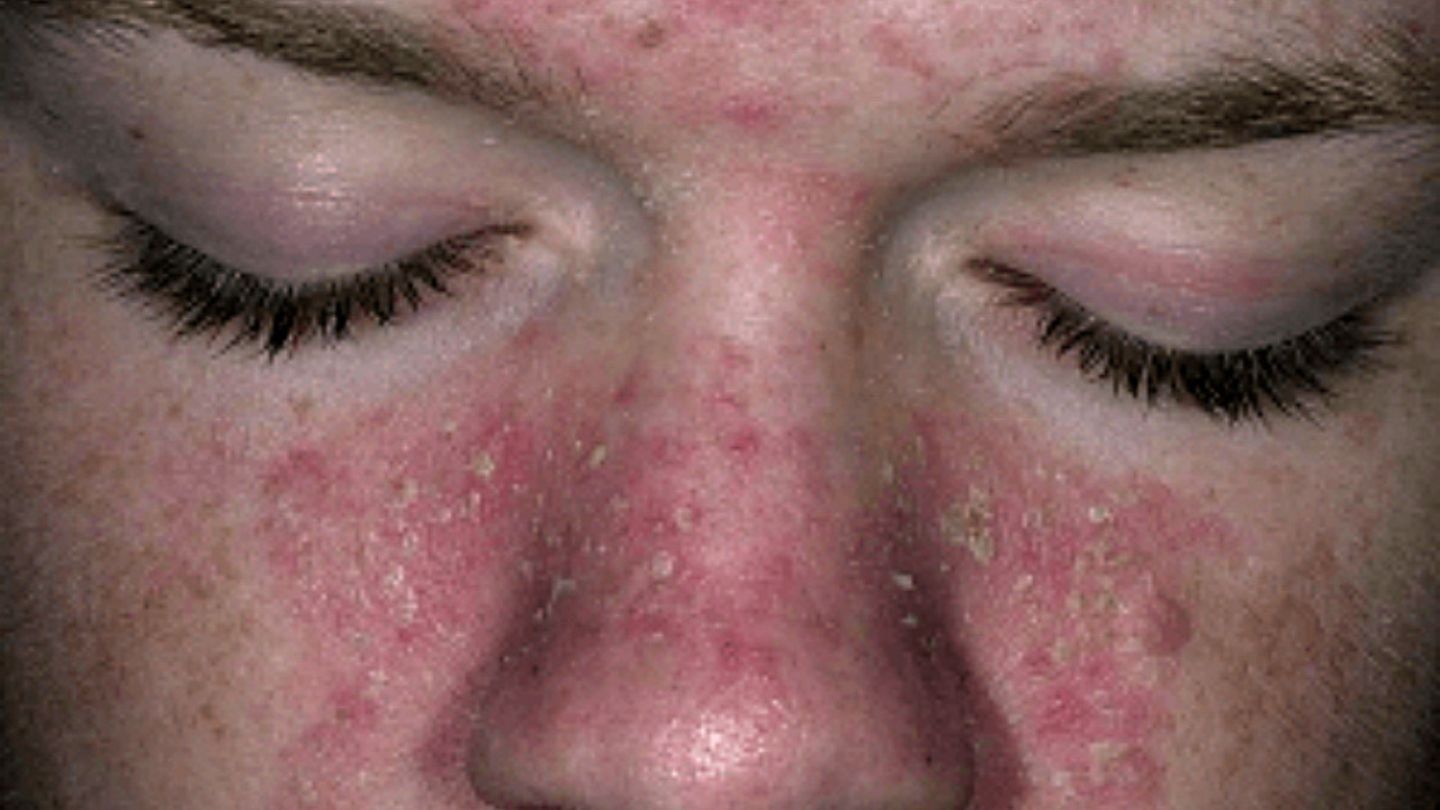
What seborrheic dermatitis is
Seborrheic dermatitis is a chronic inflammation of the skin in areas rich in oil glands. It causes greasy, yellowish or white scale on red skin, with itch and sometimes burning. The edge between affected and healthy skin is blurred.
It shows up where oil glands are densest:
- Scalp: flakes on the shoulders or scale stuck to the skin, redness along the hairline, behind the ears and on the nape.
- Face: eyebrows, the folds beside the nose, the eyelid margins, the beard area and between the eyebrows.
- Body: the centre of the chest and the ear canals.
In babies it appears in the first months as cradle cap and usually clears on its own. In adults it tends to start after puberty, when hormones boost oil production, and then returns in waves for years. It is more common in men.
What causes it
Malassezia is a yeast that lives on everyone’s skin and feeds on skin oil. It breaks the oil down into fatty acids that irritate the skin. In people prone to seborrheic dermatitis the skin reacts with inflammation, cell turnover speeds up and greasy scale forms. Genetics, the amount of oil the skin makes and how the immune system responds to the yeast all decide who develops it and how severe it gets.
The yeast does not come from outside, so it cannot be eliminated. Treatment reduces its numbers and calms the inflammation. The condition is not contagious and has nothing to do with hygiene.
Common triggers:
- Stress, tiredness and poor sleep.
- Cold, dry winter weather.
- Sweat and greasy styling products left on the scalp.
- Harsh cleansers, hair sprays and products with alcohol.
- Scratching, which feeds the inflammation.
Widespread or severe seborrheic dermatitis is linked to Parkinson’s disease and to a weakened immune system. A sudden, extensive case in an adult is a reason for a medical check.
Seborrheic dermatitis, psoriasis or dandruff
All three cause scale on the scalp, and telling them apart decides the treatment.
| Condition | Scale | Redness and border | Main treatment |
|---|---|---|---|
| Dandruff | Dry white flakes | No redness | Over-the-counter anti-dandruff shampoo |
| Seborrheic dermatitis | Greasy, yellowish, stuck to skin | Redness, blurred border | Antifungal shampoo, short anti-inflammatory course for flares |
| Scalp psoriasis | Silvery, dry and thick | Raised plaques with a sharp border, often past the hairline | Longer anti-inflammatory treatment |
The diagnosis is made by examining the scalp and the other typical areas. Lab tests are rarely needed. When the picture is unclear, Dr. Meir considers psoriasis, atopic eczema, contact dermatitis from hair dye or a new product, fungal infection of the scalp and head lice. On the face, rosacea is the most common look-alike. Some patients have features of both seborrheic dermatitis and psoriasis.
How it is treated
Medicated shampoos for the scalp
- Ketoconazole 2% (Nizoral and generics): an antifungal and the first choice in most cases.
- Ciclopirox 1%: an antifungal with a different mechanism, a good alternative when ketoconazole was not enough or irritated.
- Selenium sulphide and zinc pyrithione: reduce yeast and flaking, good for mild cases and maintenance.
- Salicylic acid and coal tar: soften and lift thick scale, used alongside an antifungal shampoo.
During a flare, wash with the medicated shampoo two to three times a week for several weeks until scale and redness settle. Massage it into the skin of the scalp and leave it for at least five minutes before rinsing. Lukewarm water is better than hot. With curly or dry hair the frequency is sometimes lowered, because frequent washing dries the hair.
Two medicated shampoos can be alternated, for example ketoconazole one wash and zinc pyrithione the next. When one ingredient stops helping after a long time, switch to another. Apply conditioner to the lengths only, so no residue stays on the scalp.
On the face
The face is treated with antifungal creams such as ketoconazole cream, and the same shampoo can be used as a short face wash on affected areas. Facial skin is thin and reacts to steroids faster, so it calls for gentle preparations.
Flares: short anti-inflammatory courses
When redness, itch and burning are strong, an anti-inflammatory is added while the antifungal continues.
- Topical steroid as a solution or foam on the scalp, or a mild cream on the face. It calms inflammation and itch within days. It is meant for short courses only, because long use thins the skin, causes visible small vessels and leads to quick relapse after stopping.
- Calcineurin inhibitors, tacrolimus (Protopic) and pimecrolimus (Elidel). They do not thin the skin and suit longer use, especially on the face, eyelids, hairline and behind the ears. They may sting for the first few days.
On hair-bearing scalp a solution, foam or gel is easier than an ointment, because it absorbs into the skin and does not stick to the hair. Creams and ointments suit hairless areas.
Note: do not use a strong steroid ointment left over from another prescription on your face or scalp. The doctor sets the strength and length of each course for each area.
Newer prescription options exist. Roflumilast 0.3% foam, a non-steroid anti-inflammatory, was approved by the FDA for seborrheic dermatitis in December 2023 from age nine. Dr. Meir discusses whether it fits when standard treatment is not enough.
Maintenance: preventing relapse
Seborrheic dermatitis moves between calm periods and flares, so control needs continuity. Once the skin calms, keep using the antifungal shampoo once a week or every two weeks, even when the scalp looks clear. Stopping completely usually brings the symptoms back, because the yeast multiplies again.
Regular antifungal shampoo works better than repeated steroid courses. Alongside it, cut down greasy styling products, avoid alcohol-based and heavily scented products and notice stressful periods. If winter is hard for you, raise the shampoo frequency a little before the cold arrives.
Results and timeline
Most mild cases respond to a pharmacy shampoo within a few weeks. With correct use of prescription treatment, scale and redness usually improve within two to four weeks, and a flare treated with a short steroid course calms within days.
See a doctor when:
- There is no improvement after four to six weeks of antifungal shampoo used as directed.
- The scale is thick, silvery or extends past the hairline.
- Pus, bleeding cracks, swollen lymph nodes or fever appear.
- There is marked hair loss or bald patches.
- It spreads to the face, ears or chest, or disturbs sleep.
Treatment at the clinic
Dr. Meir examines the scalp and the other typical areas and separates seborrheic dermatitis from psoriasis, contact dermatitis and other scalp problems. He then writes a plan for the active phase and a maintenance plan, including the shampoo, prescription preparations and the length of each course. When hair loss and scalp inflammation occur together, both are treated in the same plan. Dr. Meir has more than 20 years of experience and consults in Holon in Hebrew, English and Russian. To book, message the clinic on WhatsApp at 053-566-2287.
Questions
Does seborrheic dermatitis go away permanently?
No. It comes and goes in flares, because the Malassezia yeast that lives on everyone's skin keeps returning. Correct treatment brings long calm periods, held with a maintenance shampoo once a week or every two weeks.
How long should I leave the shampoo on?
At least five minutes before rinsing. Massage it into the skin of the scalp, not only the hair. A one-minute wash is a common reason the shampoo seems not to work.
What is the difference between dandruff and seborrheic dermatitis?
Dandruff is dry white flaking with no redness and counts as the mild end of the same tendency. In seborrheic dermatitis the scale is greasy and yellowish, stuck to the skin, with redness and itch underneath.
Does seborrheic dermatitis cause hair loss?
Strong inflammation and scratching can increase shedding for a while, and hair regrows once the scalp calms. Clear thinning or bald patches have another cause, which is checked separately.
Can I use a steroid on my scalp long term?
No. A steroid calms a flare within days but is meant for short courses. Long use thins the skin and brings quick relapse. Calcineurin inhibitors and antifungal shampoo cover the long term.
Is it contagious?
No. Seborrheic dermatitis is not an infection and has nothing to do with poor hygiene.
Related
Sources: American Academy of Dermatology: Seborrheic dermatitis, diagnosis and treatment; Clark GW, Pope SM, Jaboori KA. Diagnosis and Treatment of Seborrheic Dermatitis. Am Fam Physician 2015