
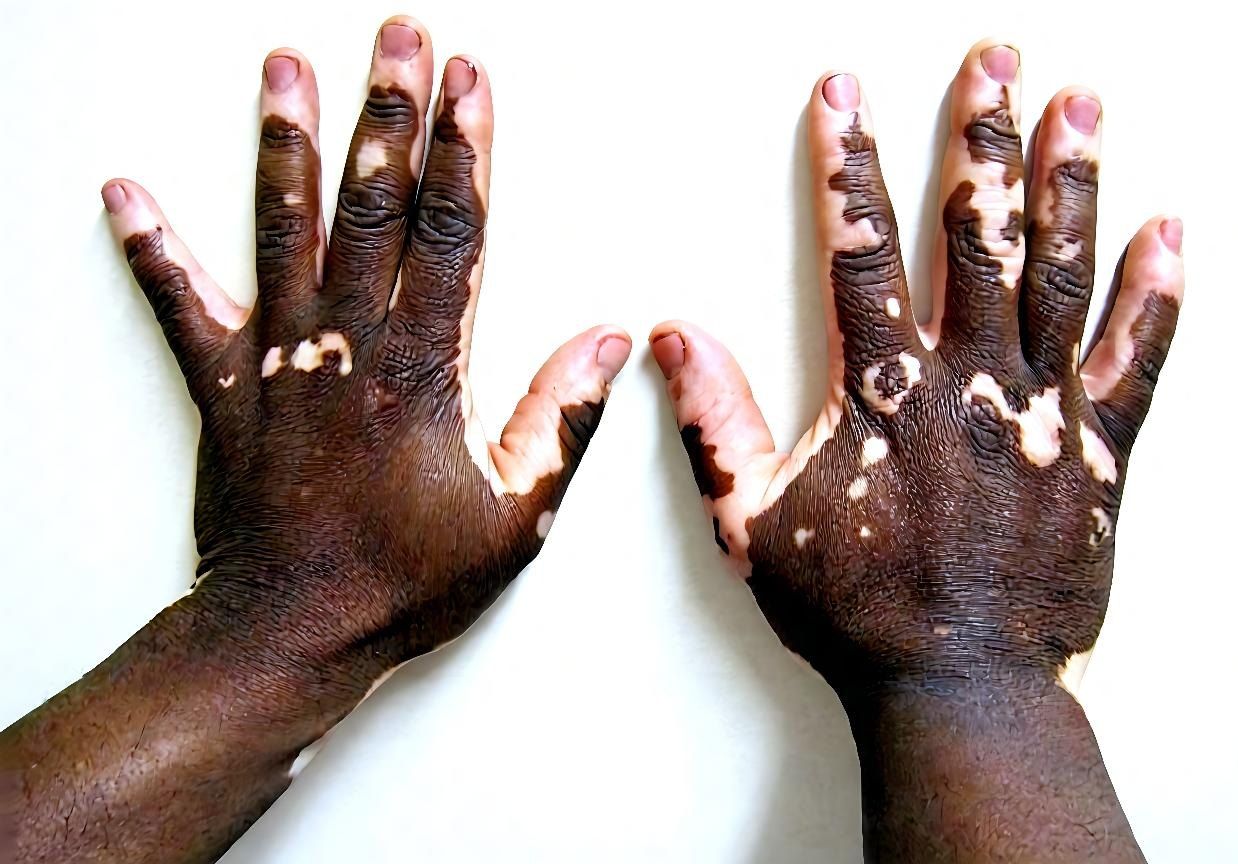
What vitiligo is
Vitiligo is a chronic skin condition in which pigment disappears from areas of skin and leaves milk-white patches with sharp, irregular borders. The skin in the patches feels the same as the rest of the skin; only the colour is missing. Vitiligo affects about 0.5% to 2% of people worldwide, in every skin tone and at any age. About half of patients notice the first patch before age 20.
Patches often appear around the eyes and mouth, on the hands and fingers, wrists, elbows, knees, feet and genitals, and in areas of friction. Hair growing in a patch can turn white too. In olive and dark skin, the contrast is stronger, which is one reason vitiligo weighs heavily on many people in Israel.
Vitiligo is not contagious, it does not hurt, and it does not damage general health. Its effect on confidence and social life is real, and that part belongs to treatment as well.
What causes it
Vitiligo is an autoimmune condition. Immune cells (T cells) attack and destroy melanocytes, the cells that make pigment. Genes play a clear part: the condition runs in some families. Triggers that can start or spread it include sunburn, skin injury (new patches can form along a scratch or cut, called the Koebner phenomenon), friction from tight clothing and stress.
Vitiligo often goes together with other autoimmune conditions, most of all thyroid disease. A thyroid blood test is part of the usual work-up.
Types of vitiligo
Non-segmental vitiligo is the common form. Patches appear on both sides of the body, often symmetrically: both hands, both knees, around the eyes and mouth. It tends to spread in phases of activity and rest over many years, and its course is hard to predict.
Segmental vitiligo affects one area on one side of the body: one side of the face, one leg, one eyebrow. It usually starts in childhood or young adulthood, spreads for about a year or two and then stops. It responds less to creams and light, and it is the form most suited to surgical grafting once stable.
Signs of active, spreading vitiligo include patches with blurred, confetti-like borders, new patches, and patches that grow in a few months. Active disease needs prompt treatment to stop the spread.
How it is diagnosed
A white patch is not always vitiligo. Other causes include pityriasis versicolor (a yeast infection), pale marks after eczema or inflammation (post-inflammatory hypopigmentation), pityriasis alba in children, small white spots from sun damage on the shins (idiopathic guttate hypomelanosis) and, rarely, other conditions.
The doctor examines the skin, often with a Wood’s lamp, an ultraviolet light under which vitiligo patches glow bright white. Questions cover when the patches started, whether they grow, family history and other autoimmune conditions. Bringing photos that show how the patches changed over time helps estimate activity.
At the clinic in Holon, Dr. Meir separates vitiligo from other causes of pale skin, checks whether a thyroid work-up is needed, and builds a treatment plan for the type and stage. Consultations are in Hebrew, English and Russian.
Treatment options
Treatment aims to stop new patches and to bring colour back. Response varies between people and between areas: the face and neck respond best, and the hands, fingertips and feet least. Repigmentation often starts as small brown dots around hair follicles inside the patch.
Creams
- Topical corticosteroids are a common first line for early, limited patches on the body. They are used in cycles, with breaks, to avoid thinning the skin.
- Calcineurin inhibitors, tacrolimus (Protopic) and pimecrolimus, calm the local immune reaction without thinning the skin. They suit long-term use on the face, eyelids, neck and skin folds, where steroids are less suitable. Their use in vitiligo is off-label.
- Ruxolitinib cream 1.5% is a JAK inhibitor and the first cream approved for vitiligo repigmentation, by the US FDA in 2022 and later in Europe. It blocks the inflammatory signal that destroys melanocytes. In the TRuE-V phase 3 trials, about 30% of patients reached 75% repigmentation of the face after 24 weeks of twice-daily use, and about 50% after one year. It is approved for non-segmental vitiligo from age 12, on up to 10% of the body surface. Availability and approval differ between countries, and the doctor checks what is currently available.
Phototherapy
Narrowband UVB is the most effective treatment for widespread vitiligo. Controlled UV light stimulates the remaining melanocytes to make pigment again. Sessions run two to three times a week over many months, and results are best on the face and trunk. Phototherapy often combines with creams for a better response. The clinic does not provide phototherapy; Dr. Meir refers patients to a phototherapy unit and keeps managing the rest of the plan. Targeted excimer light treats small, stubborn areas.
Tablets for rapidly spreading vitiligo
When vitiligo spreads fast, the doctor may give a short course of low-dose oral steroids to stop it. Oral JAK inhibitors are in clinical trials for vitiligo.
Surgery
For stable vitiligo that has not changed for at least 6 to 12 months and did not respond to other treatment, grafting of pigmented skin or cells from another part of the body is an option. It suits segmental vitiligo best and needs a specialised centre.
Depigmentation
When vitiligo covers most of the body, some adults choose the opposite route: lightening the remaining pigmented skin to an even tone. This decision is permanent and needs careful discussion.
Note: Vitiligo treatment takes months. The first dots of colour usually appear after 2 to 3 months, and judging a treatment earlier than that is too soon.
Camouflage and daily life
While medical treatment runs, cosmetic tools even out skin tone and give control over appearance day to day:
- Water-resistant, high-coverage camouflage make-up in a matching shade for the face, hands and neck
- Self-tanner (DHA), which darkens white areas for a few days without UV exposure and without affecting the condition
- Medical micropigmentation for small, stable areas such as the lips, considered with care because the colour does not change with the seasons
Self-tanner and make-up give colour but no sun protection. Skin without pigment burns fast, and a burn can trigger new patches.
Sun protection
Daily broad-spectrum sunscreen with high SPF on white areas, clothing and shade are part of treatment. They prevent burns and new patches, and they reduce tanning of the surrounding skin, which lowers the contrast. In the Israeli summer this matters from spring to autumn.
Children with vitiligo
Vitiligo often starts in childhood. Children usually begin with a mild steroid or tacrolimus cream, which is safe on the face and eyelids. Phototherapy is possible in older children who can cooperate with sessions. Ruxolitinib cream is approved from age 12. Support for the child at school and at home matters as much as the creams.
Prognosis by type
- Segmental vitiligo usually stabilises within one to two years. Colour returns less often with creams and light, and grafting is the main option once stable.
- Non-segmental vitiligo follows a course of spreading and resting phases. Early treatment raises the chance of stopping the spread and regaining colour, mostly on the face.
- Patches on the lips, fingertips and with white hairs respond least.
- After treatment stops, some colour can fade again. Maintenance creams twice a week on previously affected areas lower that risk.
When to see a doctor
Book an examination when a new white patch appears or an existing one starts to spread. Early treatment gives the best chance of stopping the spread and bringing colour back. Choosing not to treat is also a valid choice, as long as the white areas stay protected from the sun.
Questions
Is vitiligo contagious?
No. Vitiligo is an autoimmune condition. It does not pass by touch, and it does not harm general health.
Can vitiligo be cured?
There is no permanent cure, but many patients regain colour with treatment, mostly on the face. Early treatment gives a better chance of stopping the spread. Some patches can return after treatment stops, so maintenance is common.
Does ruxolitinib cream work for vitiligo?
In two phase 3 trials, about 30% of patients with non-segmental vitiligo regained at least 75% of facial colour after 24 weeks, and about half after a year. It is approved from age 12 on up to 10% of the body surface.
Is vitiligo linked to thyroid disease?
Yes, autoimmune thyroid disease is more common in people with vitiligo. Doctors often check thyroid function as part of the work-up.
How is vitiligo treated in children?
Children usually start with a mild steroid or tacrolimus (Protopic) cream, which suits the face and eyelids. Phototherapy is possible in older children. Ruxolitinib cream is approved from age 12.
Does sun help vitiligo?
Controlled UVB in a clinic setting helps. Unprotected sun burns white patches quickly, and a burn can trigger new patches. Use high-SPF sunscreen on white areas.
Related
Sources: American Academy of Dermatology: Vitiligo treatment; DermNet: Vitiligo; NHS: Vitiligo