
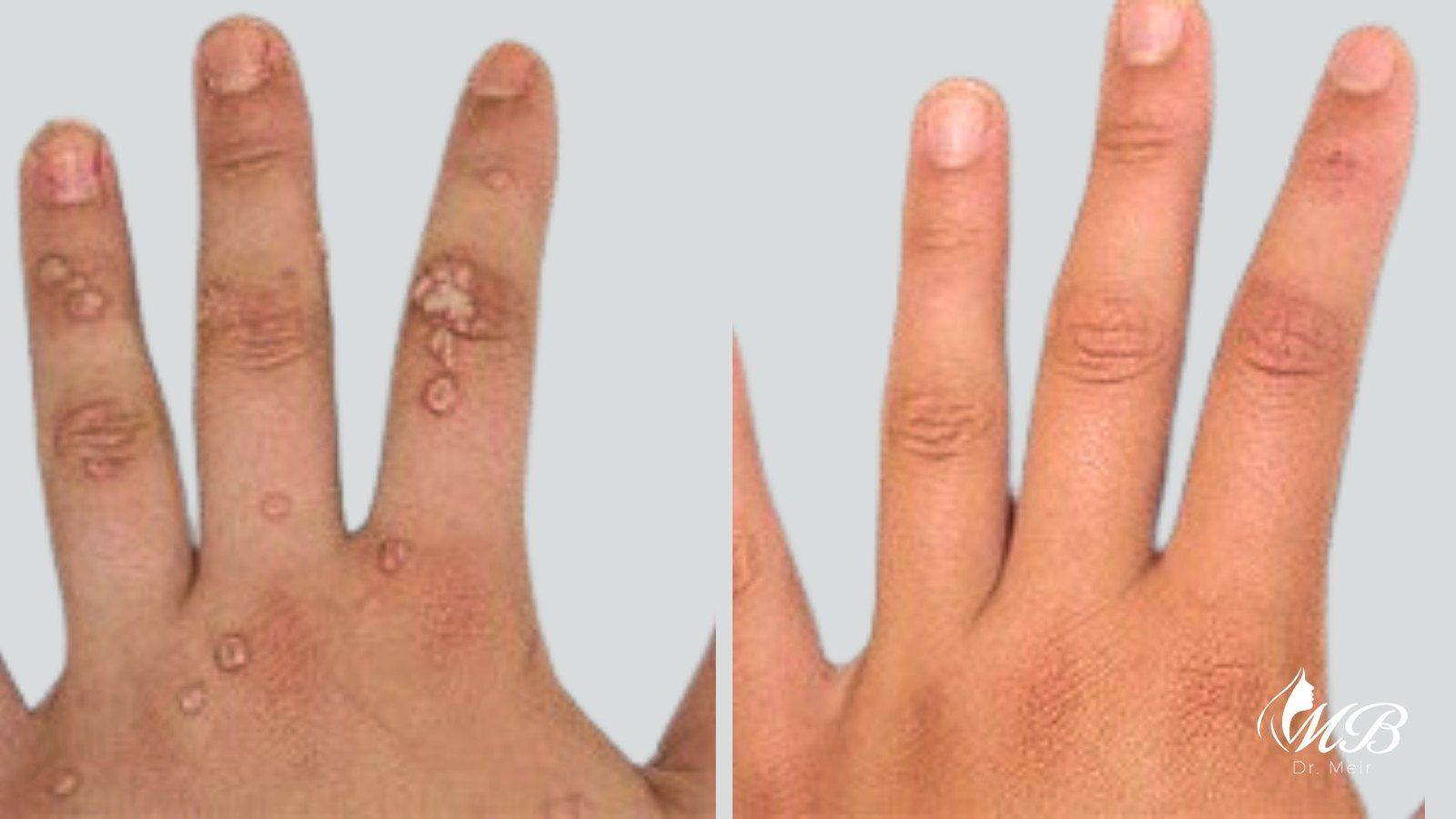
What warts are
Warts are benign skin growths caused by the human papillomavirus (HPV). The virus enters through tiny breaks in the skin and makes the cells of the outer layer multiply. Warts are common in children and teenagers, in people who use public pools and showers, and in anyone whose immune system is weakened.
Warts are harmless, but they can hurt, spread to other parts of the body and pass to family members. A growth that bleeds, grows fast or looks unusual should be examined, because a few skin cancers can look like a wart.
Types of warts
- Common warts are rough, raised bumps, mostly on the fingers, hands and knees. Small black dots inside them are clotted capillaries.
- Plantar warts (verrucas) grow on the sole. Body weight pushes them inward, so they look flat with a hard rim and hurt like a stone in the shoe. Several can merge into a mosaic patch.
- Flat warts are small, smooth, slightly raised spots, often in groups on the face, the backs of the hands and the shins. Shaving spreads them along the line of the razor.
- Filiform warts are thin, finger-like growths around the mouth, nose and eyelids.
- Periungual warts grow around and under the nails and are among the hardest to clear.
Molluscum contagiosum is a different condition caused by a pox virus. It forms small, firm, pearly bumps with a dimple in the centre, mostly on the trunk, armpits and thighs of children. In adults, molluscum in the genital area is usually sexually transmitted and calls for a check for other infections.
How wart removal is done at the clinic
Dr. Meir first confirms that the growth is a wart. Corns on the sole, seborrhoeic keratosis and some skin cancers can look similar. The plan then depends on the type, the location, the number of warts and the patient’s age.
Liquid nitrogen cryotherapy
Freezing with liquid nitrogen is the first treatment for most warts. At the clinic it is applied with a spray, which reaches a deeper freeze than a cotton bud. Each wart gets two freeze-thaw cycles, with a thin white halo of ice extending a couple of millimetres beyond the edge.
Sessions are about three weeks apart. That interval gives the immune response time to work after each freeze. Plantar warts are pared down before each session, because thick hard skin blocks the cold from reaching the infected cells. Cryotherapy is used with more caution on darker skin, where it can leave a light patch.
Salicylic acid at home
Salicylic acid in a gel, liquid or plaster is the home part of the plan. It peels the wart layer by layer and adds to the effect of freezing. Apply it every evening after soaking the wart in warm water and filing it with a disposable emery board. Cover it overnight. Continue for 12 weeks before deciding that it did not work. Stop on any area of broken or inflamed skin, and avoid it on the face.
Cantharidin
Cantharidin is a blistering agent applied in the clinic. It causes no pain at the moment of application, which makes it useful for children who refuse freezing. The doctor paints a thin layer on the wart only, it is covered for a few hours and then washed off at home. A blister forms within one to two days, dries into a crust and falls off with the wart within one to two weeks. It is also one of the main in-clinic treatments for molluscum.
Laser and excision
Warts that do not respond to several rounds of freezing can be treated with laser, which targets the blood vessels that feed the wart or vaporises it layer by layer. For a single stubborn wart, Dr. Meir may move to excision under local anaesthetic. Excision gives tissue for the lab, so the diagnosis is certain, and it relieves pain from a deep plantar wart.
Bleomycin and immune treatments
Bleomycin injected in small amounts directly into the wart is reserved for resistant warts on the hands and feet. It is not used in pregnancy, in children as a first step, or on the fingertips of people with poor circulation. The injection is uncomfortable, and the wart turns black and falls off over two to four weeks.
Imiquimod cream (Aldara) stimulates the local immune response. It is used for flat warts and as an add-on in some resistant cases. Redness at the site is expected and shows the cream is working. Intralesional immunotherapy is another option for warts that keep returning.
Warts in children
In children, the immune system clears many common warts without treatment. About half disappear within a year and about two thirds within two years. If a wart does not hurt and is not spreading, watchful waiting is a reasonable choice and avoids painful treatment.
If a wart hurts, affects walking, spreads or bothers the child socially, Dr. Meir treats it early. Cantharidin and salicylic acid are usually the first options for young children. Freezing is used when the child can tolerate it.
For molluscum, waiting is often the right call, since the bumps usually clear within 6 to 18 months. Redness and itch around the bumps often signal that the body has started to clear them. Treatment makes sense when the bumps spread fast, itch, sit on the face or genitals, or when eczema keeps spreading them through scratching.
Recovery and side effects
After freezing, the spot stings for a few hours and may blister within a day. The blister dries and falls off within one to two weeks. Keep it clean and covered with a plaster, and do not pop it. After cantharidin, expect a blister and pressure-like soreness for a day or two. After excision, the stitches come out after one to two weeks.
Possible side effects include a light or dark mark, a small scar, and, rarely, a ring of new warts around a treated one. Most marks fade over months.
Note: Over-the-counter freezing sprays reach a much milder cold than liquid nitrogen. They are fine for a small, fresh wart, but do not use them on the face, on a growth that has not been diagnosed, or on a child’s skin without advice.
Preventing warts and repeat infections
- Wear flip-flops in pools, gyms and shared showers.
- Do not pick or bite warts, and keep a separate file or emery board for each wart.
- Do not shave over flat warts.
- Keep feet dry and change socks daily.
- Treat eczema, because damaged skin lets the virus in more easily.
When to see a doctor
Book a consultation for a wart that hurts, spreads, sits on the face or genitals, or does not improve after 12 weeks of home treatment. Any growth that bleeds without reason, changes colour or grows fast should be examined before it is treated. The clinic in Holon sees adults and children, with consultations in Hebrew, English and Russian.
Results from the clinic
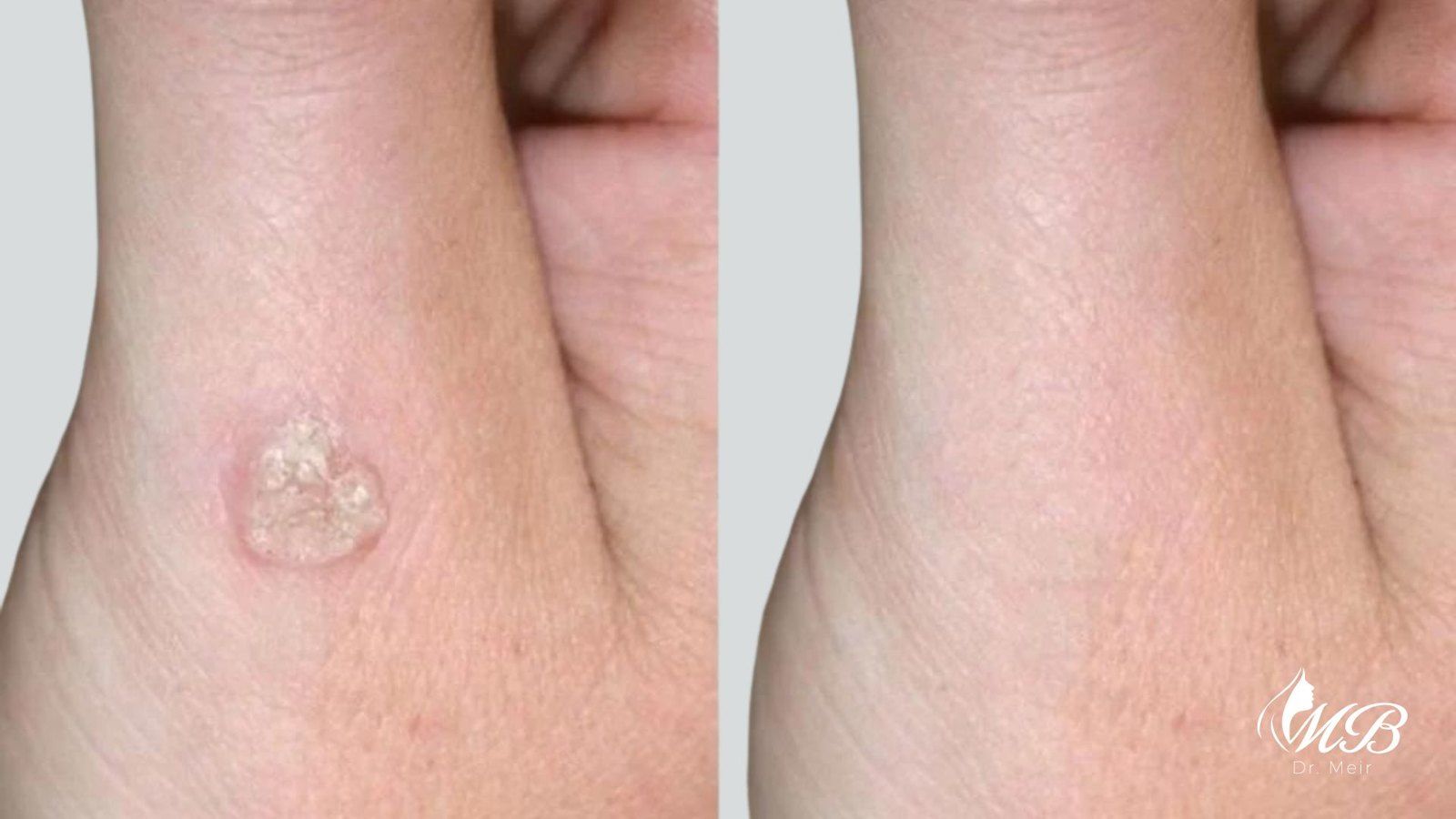
Individual results vary. Photos published with patient consent.
Questions
Are warts contagious?
Yes. Warts spread through direct skin contact and through wet floors in pools and showers. Picking, biting nails and shaving spread them to new spots on the same person.
Does wart freezing hurt?
Freezing stings for a minute and the spot can throb for a few hours. A blister may form within a day. On the sole it can be sore to walk on for a few days.
How many sessions does a wart need?
A common wart on the hand often needs 3 to 4 sessions about three weeks apart. Thick plantar warts and warts around the nails need more and respond less.
Should I treat my child's warts or wait?
Many warts in children clear on their own within one to two years. If a wart hurts, spreads or bothers the child, it is treated, often with cantharidin, which does not hurt during application.
Why does my wart keep coming back?
The virus can stay in the skin around the treated wart. Stopping salicylic acid too early, skipping the filing step and long gaps between sessions are common reasons. Warts that do not respond are reviewed and, if needed, removed and sent to the lab.
How is molluscum different from warts?
Molluscum contagiosum is caused by a pox virus. It forms small pearly bumps with a dimple in the centre, mostly in children and on the trunk, and usually clears within 6 to 18 months.
Related
Sources: NHS: Warts and verrucas; American Academy of Dermatology: Warts diagnosis and treatment; NHS: Molluscum contagiosum